Article 4·P14·v3.0
Better Forecasts Are Not Yet Learning to Act: Bounded Beliefs, Prediction Accuracy and the Limits of Learning in an Artificial Society
A bounded belief predictor forecast a child's energy better at +1 and +4 ticks but failed the preregistered +12-tick gate, so no action experiment followed.
SHING CIVITAS Research Series · Article 4 · Study P14 · Version 3.0, bibliography and model-identity revision, 2026-11-12 · Status: published on the SHING CIVITAS website, 2026-11-12; not externally peer reviewed
Terms such as tick, world, seed and controller are explained in the introductory article.
1. Title and Abstract
Abstract
An agent that records what happened to a child does not thereby know why it happened, and a better forecast of the child's condition does not show that the agent knows what to do.
P14 added to the simulated residents a bounded belief bank: for each of at most four children, a mixture of 12 hypotheses about the child's hidden food reserve (0, 1, 3 or 6 units) and daily drain (1, 2 or 3), updated only from the child's visible body energy and the resident's own delivery receipts. Four predictors were scored on identical labels: persistence, an endpoint extrapolation, a finite-history nearest-neighbour predictor, and the belief mixture, at +1, +4 and +12 ticks. The unit of inference is the world (40 confirmation seeds, 3101–3140; 36–37 eligible per horizon); the primary test is the paired difference in finite-distribution CRPS (lower is better) between the belief predictor and the finite-history predictor, with two-sided exact sign tests, 10,000-resample seed-paired bootstrap intervals and Holm correction over the three horizons. Success also required at least 30 eligible worlds and a mean world-relative reduction of at least 5%; the gate to a behavioural experiment required all three horizons.
At +1 tick CRPS fell by 0.511 (95% CI −0.604 to −0.415; 37 worlds; world-relative −18.95%; Holm p = 2.2×10⁻⁶) and at +4 ticks by 1.292 (−1.509 to −1.081; 37 worlds; −25.97%; Holm p = 4.4×10⁻¹¹). At +12 ticks the difference was −1.003 (−1.990 to −0.099; 36 worlds; −0.63%; 17 worlds higher, 19 lower; Holm p = 0.868), so the gate failed and no behavioural experiment was run. A post-hoc ablation suggests that, at +1 and +4 ticks, the advantage depends on the retained history, not only on the built-in prior; a post-hoc audit found a timing defect in how some delivery receipts were recorded (226 of 3,142 receipts, in 13 worlds), which has not been repaired.
Bounded beliefs improved short-horizon probabilistic forecasts of child condition in this model; a general advantage across horizons was not established, and nothing was tested about action or survival. This is not evidence of causal learning, and it does not describe humans.
Keywordsbounded rationalitybelief updatingprobabilistic forecastingCRPSpreregistered gateartificial society
2. Research Background
Articles 1 and 2 showed two obstacles to autonomous behaviour: a decision process cannot value an action it never considers, and it cannot value a delayed benefit it cannot attribute to its own action. A natural next step is to give a resident a private belief about what it cannot see, namely the hidden stores of a child it might feed, and ask whether the belief predicts the child's future condition better than simpler rules. Bounded-rationality accounts stress that real decision-makers carry limited, fallible representations rather than the world's true state [1], and Bayesian filtering provides a standard way to update beliefs from partial observations [2].
Forecasting research supplies the scoring tool. A probabilistic forecast should be judged by a proper scoring rule, so that honesty about uncertainty is rewarded and over-confidence penalised; the continuous ranked probability score (CRPS) is one such rule for forecasts of a numeric quantity [3,4]. A forecast that scores well is, however, not an explanation. Two children who look identical may differ in hidden stores and then diverge; a forecaster can exploit regularities in body history and receipts without identifying what an action causes. P14 therefore tests prediction first and states in advance that prediction is never to be labelled causal learning or autonomy.
3. Research Questions and Hypotheses
(Q1) Does a bounded belief predictor outperform a strong finite-history predictor in forecasting a child's body energy at +1, +4 and +12 ticks? (Q2) If so at all three horizons, is that enough to justify a later experiment in which the belief informs action? (Q3) What do visible body states fail to reveal about hidden stores?
| ID | Hypothesis (frozen) | Primary test |
|---|---|---|
| H1 | At +1 tick the belief predictor has lower CRPS than finite history | belief − history, per-world mean CRPS, < 0 |
| H2 | The same at +4 ticks | same |
| H3 | The same at +12 ticks | same |
Decision rule. A horizon is supported if at least 30 worlds are eligible, the 95% interval's upper limit is below zero, the Holm-adjusted p is below 0.05 (two-sided exact sign test; zeros excluded), and the mean world-relative CRPS reduction is at least 5%. Gate: all three horizons must be supported, and the belief predictor's mean CRPS must be no worse than persistence and endpoint at every horizon. If the gate fails, no belief-informed choice arm, no preference change and no enlarged search would be run.
4. Research Design
World. The P12 legal_both world (Article 1): 480 ticks, unchanged choices and physiology, with the belief bank switched on as a prediction-only library. It has no output to action and no reward; its presence changes none of the residents' behaviour (verified by per-tick projection against the bank-off world, an engineering check, not a statistical result).
What each adult may know. Per adult decision turn, one packet about a family child: identity, position and visible body energy within the daylight visual radius, selecting an exact-deadline pending target if visible, otherwise the lowest-energy, nearest, lowest-ID visible child. No hidden inventory, age, illness, other residents' actions, cause of death or future observation. The resident's own positive deliveries are recorded as receipts. Missing a sighting is not treated as death.
Four predictors on identical labels.
- Persistence: the last seen energy.
- Endpoint extension: mean energy change by band (<45, 45–75, ≥75) × whether the resident itself has just handed over food, per horizon.
- Finite history: the four nearest of the last 16 exactly observed transitions at that horizon (distance in initial body energy; mismatch in handover penalised); equal-weight empirical changes; persistence if no data. It has access to the same history and receipts as the belief predictor.
- Bounded belief: 12 hypotheses (hidden reserve {0,1,3,6} × drain {1,2,3}); each hypothetical transition burns the hypothesised drain, eats whole meals while energy is below 75 (+12 energy per meal) and clips to 0–100; the resident's own delivery increases the guessed reserve (capped at 20); each visible body updates weights with a Gaussian likelihood (σ = 6) and a 10% mixing with the prior; gaps drift weights toward uniform and gaps over 24 ticks reset the belief. At most four children are tracked (least-recently-used). This is an authored, fallible physiological prior, not learned true dynamics and not a causal estimator.
All four are converted to distributions by the same discrepancy kernel (−4, 0, +4 with weights 0.2, 0.6, 0.2) so that CRPS can be computed; persistence and endpoint therefore have no native uncertainty, and the kernel is a scoring device, not a claim that they are calibrated.
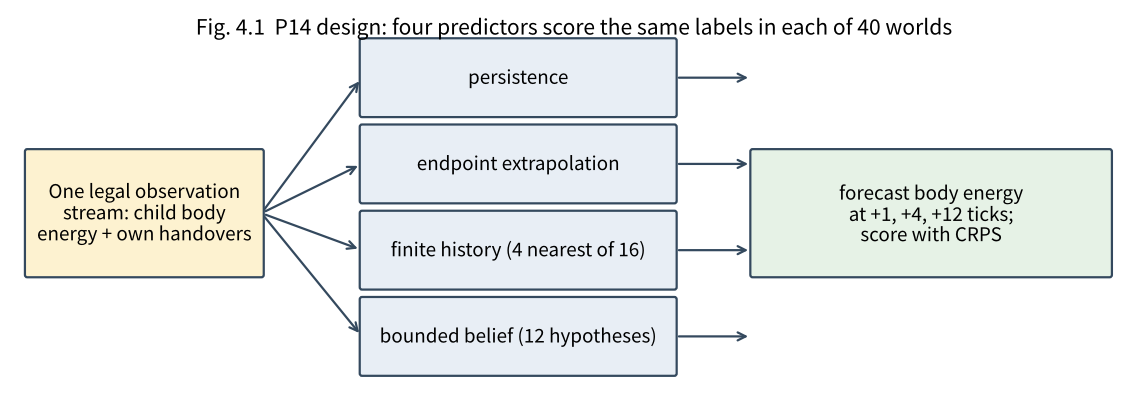
Fair access, not identical computing. All predictors use the same legal observations and receipts and the same update opportunities; they differ in computation (belief propagates 12 hypotheses; history scans up to 16 records), so the comparison tests information use, not equal capacity.
Missing labels. A forecast is scored only if the same actor stores the same child's body packet at the exact decision tick. Missing targets are unknown, deaths of the forecaster are unresolved, and horizons beyond the end of the world are right-censored; none is converted to death or zero energy. Primary scoring uses forecasts issued from tick 24 onward.
Negative control (hidden stock). Seeds 3301–3340 (39 eligible states; seed 3314 ineligible and not replaced; 156 branches): at a state with a visible child, the hidden food of the child was set to 0 or 4 and the next focal action was care or rest, each branch run 12 ticks. The control checks that visibly identical states can have different futures.
Seeds. Development 9801–9807 (read-only checks); pilot 3001–3002 (technical checks only); confirmation 3101–3140; independent controls 3301–3340. The frozen protocol also included deterministic replays and comparisons against earlier configurations.
5. Variables and Operationalization
| Variable | Role | Operational definition | Unit |
|---|---|---|---|
| Predictor (persistence, endpoint, history, belief) | Independent (within world) | Rule that produces a forecast distribution for a child's energy | categorical |
| Horizon | Independent | +1, +4, +12 ticks (4, 16, 48 model hours) | ticks |
| CRPS | Primary dependent | Exact finite-distribution CRPS of the forecast distribution for the later observed body energy (0–100 scale) | energy units (lower is better) |
| World mean CRPS | Unit of analysis | Mean over a world's eligible mature labels, for each predictor on the same labels | energy units |
| World-relative CRPS reduction | Criterion | Mean over worlds of the per-world relative change, belief vs history | percent |
| Brier score (weak body < 45), MAE of distribution mean | Secondary | Probability forecast of energy < 45; absolute error of the forecast mean | score; energy units |
| Label status | Descriptive | created, observed, unknown, actor not resolved, right-censored | count of labels |
| Hidden stock (control) | Independent (control) | 0 or 4 food units at the same visible state | units |
| Controls | Fixed | P12 legal_both world, 480 ticks, same labels for all four predictors | — |
6. Sample and Experimental Units
Forty confirmation worlds (seeds 3101–3140). Each horizon requires at least 20 observed mature-period labels per world and at least 30 eligible worlds overall. Eligible worlds: 37 at +1, 37 at +4 and 36 at +12 (worlds 3113, 3127 and 3132 are excluded at +1 and +4 and 3133 additionally at +12 for too few mature labels; excluded worlds remain in the data). The four predictors are paired on the same labels; they are not 160 independent worlds. The 19,207 prediction labels created per horizon (Table 4.2) are not independent samples. Final populations were 3 to 11; no world went extinct. Conditional scores describe only children who were seen, not dead or unobserved children.
7. Methods and Statistical Analysis
Per world, the mean CRPS of each predictor over identical labels was computed; the primary quantity is the per-world mean difference (belief − finite history). We report its mean over eligible worlds, the 95% percentile bootstrap interval (10,000 resamples of worlds, fixed generator), the number of worlds with a positive or negative difference, and a two-sided exact sign test (zeros excluded), with Holm adjustment over the three horizons. A negative difference favours the belief predictor. The decision rule above combines the interval, the adjusted p, a minimum of 30 eligible worlds and a 5% world-relative reduction. Secondary scores (MAE, Brier, ratios of mean scores) are descriptive. Post-hoc analyses were run after the confirmation and are labelled as such. With 40 worlds, a directional win needs a large majority of seeds (roughly 29 of 40 at the first Holm step); a non-significant result is not equivalence.
8. Results
8.1 Primary comparison
Table 4.1. Belief minus finite history, CRPS (energy units; negative favours belief).
| Horizon | Eligible worlds | Mean CRPS difference | 95% CI | Worlds lower / higher | World-relative change | Holm p | Supported |
|---|---|---|---|---|---|---|---|
| +1 tick | 37 | −0.511 | [−0.604, −0.415] | 33 / 4 | −18.95% | 2.17×10⁻⁶ | Yes |
| +4 ticks | 37 | −1.292 | [−1.509, −1.081] | 37 / 0 | −25.97% | 4.37×10⁻¹¹ | Yes |
| +12 ticks | 36 | −1.003 | [−1.990, −0.099] | 19 / 17 | −0.63% | 0.868 | No |
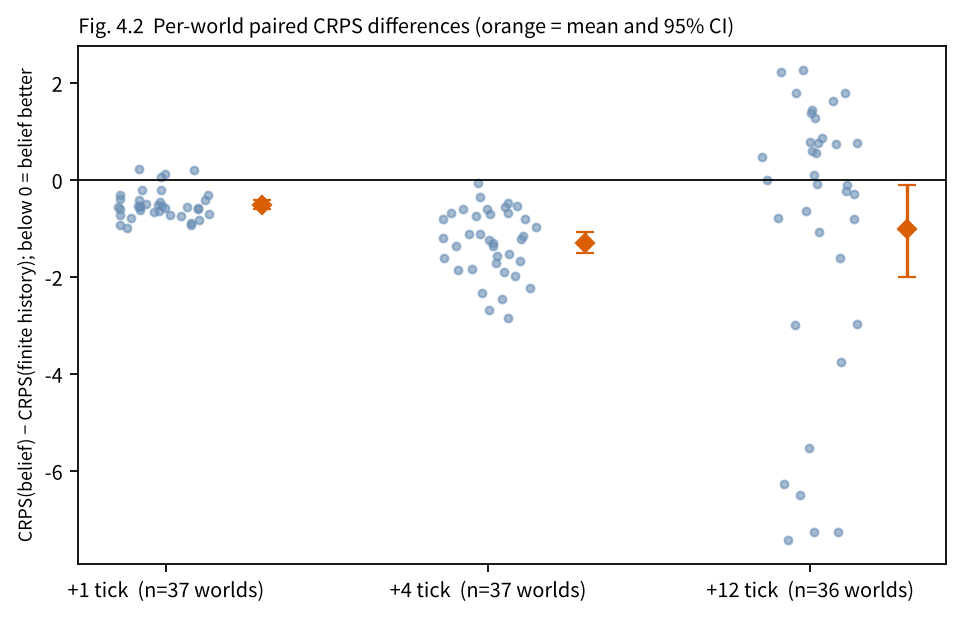
Reading. At +1 and +4 ticks the belief predictor was better in 33 of 37 and 37 of 37 worlds, by about a fifth and a quarter in the preregistered relative measure, with intervals far from zero; both horizons meet every criterion. At +12 ticks the average difference is similar in size to +4 (−1.0), and its bootstrap interval does exclude zero, but the world-level signs are split almost evenly (19 lower, 17 higher), so the sign test gives Holm p = 0.868, and the mean world-relative reduction (0.63%) is far below the required 5%. The mean difference is therefore driven by a minority of worlds with large differences. Under the frozen rule the +12 test is not supported; selecting the interval alone would reverse the decision. (Computed here from the model-score table, the ratio of the mean CRPS values is −11.1% at +12, −21.1% at +1 and −27.3% at +4; it is shown only to illustrate that the two relative measures diverge at +12, and it is not the frozen criterion.)
8.2 Scores of all four predictors
Table 4.2. World-averaged scores on mature labels (descriptive; lower is better).
| Horizon | Predictor | CRPS | MAE of mean | Brier (energy < 45) |
|---|---|---|---|---|
| +1 | belief | 1.915 | 2.592 | 0.0090 |
| +1 | finite history | 2.426 | 3.190 | 0.0111 |
| +1 | persistence | 2.636 | 3.203 | 0.0133 |
| +1 | endpoint | 2.709 | 3.270 | 0.0109 |
| +4 | belief | 3.446 | 4.523 | 0.0223 |
| +4 | finite history | 4.738 | 6.002 | 0.0327 |
| +4 | persistence | 5.765 | 6.803 | 0.0482 |
| +4 | endpoint | 5.356 | 6.255 | 0.0330 |
| +12 | belief | 8.022 | 10.875 | 0.0746 |
| +12 | finite history | 9.025 | 10.491 | 0.0841 |
| +12 | persistence | 10.125 | 11.100 | 0.1175 |
| +12 | endpoint | 10.384 | 11.356 | 0.1133 |
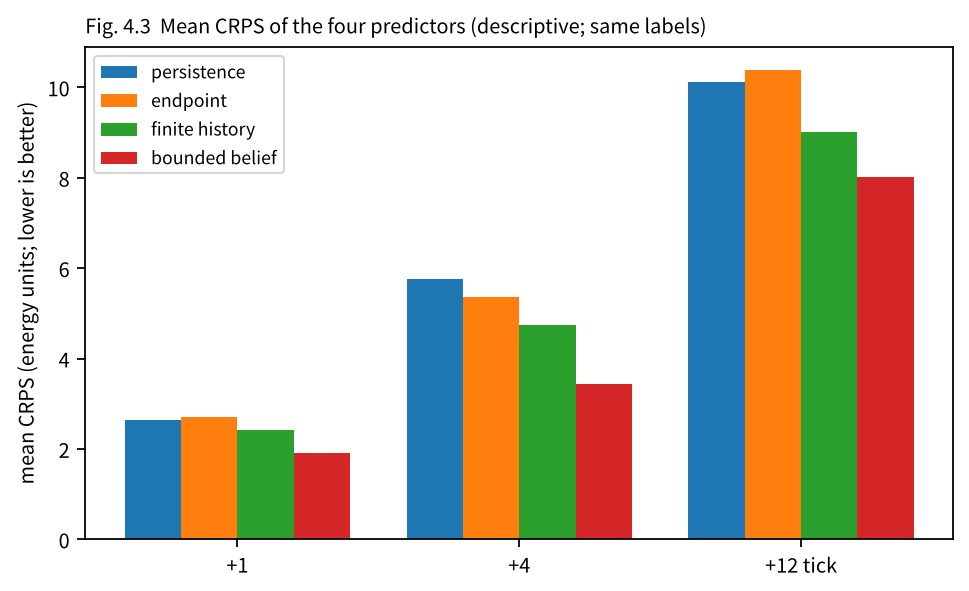
At +12 ticks the belief predictor's CRPS is lowest but the error of its mean (10.875) is larger than that of finite history (10.491): its advantage there lies in the shape of its distribution rather than in a better central estimate. The belief predictor's mean CRPS was below persistence and endpoint at all three horizons, so that part of the gate was met; the gate failed because the +12 primary was not supported.
Table 4.3. Prediction labels created and their status (pooled over 40 worlds; not independent samples).
| Horizon | Created | Observed | Unknown (not seen) | Actor not resolved | Right-censored |
|---|---|---|---|---|---|
| +1 | 19,207 | 17,046 | 2,129 | 10 | 22 |
| +4 | 19,207 | 15,380 | 3,690 | 37 | 100 |
| +12 | 19,207 | 15,608 | 3,174 | 122 | 303 |
The share of unknown labels is substantial (11% at +1, 19% at +4, 17% at +12), and because the selector prefers earlier-due items, counts across horizons are not nested and cannot be read as longer horizons being easier to know. Errors are conditional on a child being seen at the issuing tick.
8.3 Negative control: hidden stock
Across the 39 eligible stock-twin states, all private banks, the current legal view and all three predictions were identical between the stock-0 and stock-4 twins before divergence, as designed. After the hidden stock was raised from 0 to 4 and the focal adult rested, the child's body outcome at +1 tick differed in all 39 pairs, by about 36 energy units on average; differences persisted among children alive at +4 and +12. This supports the statement that visibly identical states need not have identical futures; it is not a label an agent can use, and after divergence other behaviour and random consumption change, so later differences cannot be attributed to a single meal or a single act of care.
8.4 Post-hoc analyses (not preregistered)
Fixed-prior ablation. After the confirmation run, each forecast was re-scored with the personal history reset (only the current body, the current receipt and the original prior retained; no parameters fitted). Filtered minus fresh-prior CRPS was −3.302 (95% CI −4.423 to −2.272) at +1, −2.512 (−3.654 to −1.475) at +4 and −0.106 (−1.249 to 0.935) at +12. This suggests that at short horizons the advantage is not only the built-in prior and that retained history and past receipts matter; at +12 the retained history added little. The ablation removes history and receipts together, is not independently confirmed and cannot separate their contributions or establish causal learning.
Timing defect. An audit of delivery receipts found that of 3,142 positive transfers, 226 across 13 worlds were credited to a body record from an earlier time (gaps up to 127 ticks), and some had no retained target. Archived predictions and deterministic replays are unchanged, but a versioned repair and confirmation with new seeds have not been done. The results must therefore not be cited as verified long-horizon temporal credit assignment.
Counter-examples. In the confirmation worlds there were 6,058 +12-tick cases of a child recovering without a delivery from the forecaster and 968 cases of a child worsening after one; these do not exclude help from others or earlier help and illustrate why recovery cannot simply be credited to an act.
9. Discussion
The central finding is a bounded, qualified success followed by a pre-agreed stop. The belief predictor reliably improved the probabilistic forecast of a child's body energy over finite history at one and four ticks. At twelve ticks, the evidence does not support a general advantage, and the gate that the project had written for itself was not met. Honouring the gate is the main methodological point: two favourable horizons were not allowed to license the next stage.
Why might the short-horizon advantage fail to extend? Several accounts remain open: the 12-hypothesis prior covers a limited range of reserves and drains; at longer horizons unobserved events (other residents' help, illness) dominate; the timing defect may contaminate receipt-based updates; and the sample of eligible worlds is small. The ablation hints that retained history helps most at short horizons. None of these accounts is tested here.
The control shows the deeper limit. Two children with identical visible bodies but different hidden stores diverge, so a forecaster that sees only the visible body is bounded no matter how well it is built; and prediction under such bounds does not tell an agent which action would change the outcome. Article 1's forced-care forks show that care can matter, but nothing in P14 gives a resident a way to learn that from outcomes. Connecting forecasts to action values would require a separate, preregistered experiment that was deliberately not run.
Relation to prior work: probabilistic forecast evaluation by proper scores [3,4] and belief filtering [2] are standard; the contribution here is the preregistered gate and its honest application, not a new algorithm.
10. Limitations
- Simulation only; no inference about humans or real child welfare.
- Prediction, not action. No behavioural, survival or learning effect was tested; the bank has no readout.
- Authored prior. The belief model is a fallible physiological prior with a small hypothesis grid; it is not learned dynamics.
- Known unrepaired timing defect (226 of 3,142 receipts in 13 worlds) and no confirmation on new seeds.
- Small, selected sample. 36–37 eligible worlds; conditional on children being seen; unknown labels 11–19%; dead or unobserved children are not scored.
- Unequal computation. Comparisons give equal information access, not equal capacity.
- The common kernel used to score persistence and endpoint is a device, not a calibration claim.
- Post-hoc analyses are exploratory.
- Governance. Internal preregistration; no external replication; the package's analysis scripts import undistributed modules; protocols were drafted with an AI coding assistant under the owner's direction (wording to be confirmed).
11. Conclusion
In this artificial society, a bounded belief about a child's hidden food reserve produced better probabilistic forecasts of the child's body energy than a strong finite-history baseline at one and four ticks, in nearly all worlds, but not at twelve ticks, where the preregistered criteria were not met. Because the gate required all three horizons, no experiment on acting from these beliefs was run, and no claim is made about causal learning, behaviour or survival. The stop, together with a known and unrepaired timing defect, defines the next step: repair the accounting, confirm on new seeds, and only then ask whether such forecasts can support action.
12. Data Availability and Reproducibility
The evidence package SC-P14-Bounded-Beliefs contains the frozen protocol, audit and report, the post-hoc note, the confirmation analysis, post-hoc prior-ablation and temporal-audit files, analysis scripts and chart data (per-world CRPS differences, model scores, label accounting), under CC BY 4.0 (data, documents) and MIT (scripts). For this edition the three primary contrasts and the model scores were recomputed from the provided per-world rows and match the frozen files. The simulation engine, dependency locks and event streams are not distributed, so the simulations cannot be re-run; analysis scripts import undistributed modules. Names inside the package still use the earlier name "Emergentia". Release status: version 1.0.0 published for public download on 2026-11-12 (see the dataset panel below).
SHING CIVITAS P14 Bounded Beliefs Dataset
SHING CIVITAS P14 有限主观信念研究数据集
Comparison of four predictors sharing one observation stream on exact finite-distribution CRPS at +1, +4 and +12 ticks over 40 paired worlds, with an inventory-twin negative control and post-hoc notes. The +12-tick gate did not pass and is retained as a negative result.
- Version
- v1.0.0
- Creator
- Martin Zhong
- Publisher
- SHING CIVITAS
- Released
- November 12, 2026
3e0a16c598a2df014e9a8f481ebe39d6c773f66b7eececfea06b9accad44d205Verify after download: sha256sum SC-P14-Bounded-Beliefs-v1.0.zip · PowerShell Get-FileHash SC-P14-Bounded-Beliefs-v1.0.zip
Data, figures and documentation: CC BY 4.0. analysis/ scripts: MIT. The simulation engine is not included. Full licence texts are in LICENSES/; the per-file map is metadata/LICENSE_MAP.md.
Zhong, M. (2026). SHING CIVITAS P14 Bounded Beliefs Dataset (Version 1.0.0) [Data set]. SHING CIVITAS. https://shingcivitas.com/
BibTeX
@dataset{zhong2026_p14boundedbeliefs,
  author    = {Zhong, Martin},
  title     = {SHING CIVITAS P14 Bounded Beliefs Dataset},
  year      = {2026},
  version   = {1.0.0},
  publisher = {SHING CIVITAS},
  url       = {https://shingcivitas.com/}
}
Entry type @dataset requires biblatex; classic BibTeX reports it as unknown. Machine-readable citation metadata: CITATION.cff (CFF 1.2.0) inside the ZIP. No DOI has been assigned.
- Recalculating results from the data
- supported — aggregate statistics can be recomputed from data/ with any CSV/JSON tool or the statistical functions in analysis/
- Reproducing the published statistical analysis
- partial — analysis/*.py document the frozen statistical rules but import private modules (civlab, scripts, p12_study) that are NOT distributed, so the pipeline cannot run end to end
- Re-running the simulations
- not supported — engine source, dependency lock, per-tick event streams, model version snapshot and API credentials are absent by design
Inside: README.md (overview), CITATION.cff, LICENSE and LICENSES/, metadata/LICENSE_MAP.md, metadata/CHECKSUMS.sha256. File names inside still use the project’s earlier name “Emergentia”.
References
Publication records, publisher pages and DOI metadata were checked on 2026-11-12. These external works support the theoretical or methodological background, not any SHING CIVITAS result.
- 1Simon, H. A. (1955). A behavioral model of rational choice. The Quarterly Journal of Economics, 69(1), 99–118. https://doi.org/10.2307/1884852
- 2Särkkä, S. (2013). Bayesian Filtering and Smoothing. Cambridge University Press. https://doi.org/10.1017/CBO9781139344203
- 3Matheson, J. E., & Winkler, R. L. (1976). Scoring rules for continuous probability distributions. Management Science, 22(10), 1087–1096. https://doi.org/10.1287/mnsc.22.10.1087
- 4Gneiting, T., & Raftery, A. E. (2007). Strictly proper scoring rules, prediction, and estimation. Journal of the American Statistical Association, 102(477), 359–378. https://doi.org/10.1198/016214506000001437
- 5Holm, S. (1979). A simple sequentially rejective multiple test procedure. Scandinavian Journal of Statistics, 6(2), 65–70. https://www.jstor.org/stable/4615733
Verification register: See Appendix C · Reference register for source links, bibliographic corrections and scope.