Field Notebook of a Civilization Observer
A guide to the papers, not new results. Every number here is copied from the papers, which remain the authoritative record.
SHING CIVITAS
Field Notebook
of a Civilization
Observer
Volume I · Observations P10–P19
Kept by the SHING CIVITAS research project · 2026
Before the first entry
How to read this notebook
This notebook retells four experiments for first-time visitors. Every number is copied from the research papers, which remain the authoritative record. The hand notes in blue are the observer’s interpretation; they add no results.
The residents are software, the world is a simulation, and nothing written here describes real people, families or economies.
- Recomputed
- statistic recomputed from per-world rows for v3.0
- blue ink
- the observer’s marginal notes
- plates: figures taken from the papers — tap to enlarge
The question that runs through every page: when something social happens, did a resident decide it — or did a rule written by the researcher produce it?
Prologue · the world
The world, one tick at a time
- 6 ticks make a model day; 120 a model year.
- A standard run lasts 480 ticks — four model years.
- Energy runs 0–100; one unit of food gives 12. Children cannot gather; they depend on adults.
- A child needs about 1,680 ticks to grow up, so no study here follows a generation.
Short horizons. Remember this when a result sounds large.
Prologue · method
Twin worlds
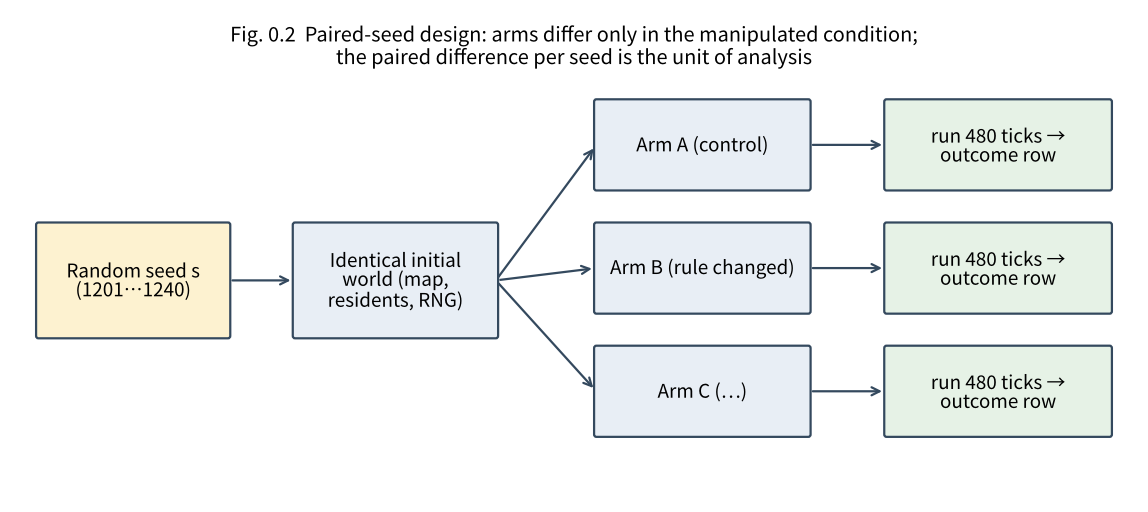
A seed fixes the starting world. Run the same seed under two conditions (arms) and the difference belongs to the condition. A fork copies a world mid-run and changes one thing.
The unit is the world, never the resident. Forty paired worlds can only show large, consistent effects.
Who feeds the children?
In the default world the engine quietly moved food between family members every tick. P10 switched that rule off.
+1.425 child starvation deaths per world 95% CI 1.050–1.800 · Holm p = 5.23×10⁻⁷ Recomputed
Residents did start caring more (+6.125 transfers per world), but not enough to replace the rule.
The old utility table lost no extra child (0.000 per world) — because caring was written into its table. Outcome present ≠ decision present.
Entry I, continued
One act of care
From 38 snapshots, one adult was forced to care or to rest at a single moment, and the child was followed for 48 ticks.
Difference +0.2895 (descriptive 95% CI 0.1316–0.4474). Researcher-forced; in 36 of 38 pairs the adult already held ≥ 12 food.
A cue and a neutral guess
Pointing attention at a weak child and valuing untried actions at an aspiration level lowered child starvation by 0.475 per world (P11) and 0.600 under the legal-information contract (P12).
…but versus the earlier contract, no clear survival gain (−0.075, CI −0.400 to 0.250).
Read Article 1 →The ledger of a tool
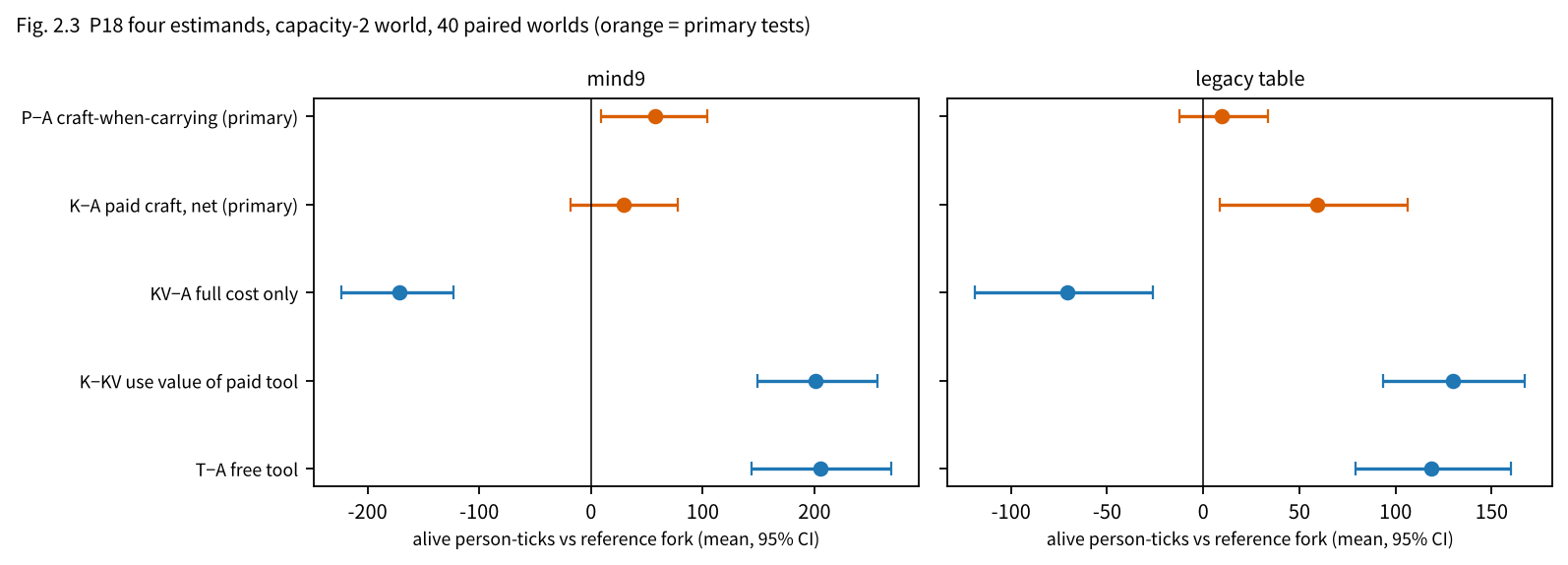
Under scarcity (food capacity 2), a tool is worth having. But is it worth making? The observer opened a ledger, in alive person-ticks over 240 ticks:
mind9, 40 paired worlds. K − A: 95% CI −18.375 to 77.825, Holm p = 0.337 — not supported. The two ≈ rows are secondary, uncorrected.
Useful ≠ worth making. The cost lands now; the benefit arrives later, where mind9 cannot see it.
Entry II, continued
What has value under scarcity?
Free tool: +144.425 person-ticks in the food-capacity-2 world (Holm p = 3.25×10⁻⁶). Food top-up: +465 to +3,135. A free house met the criterion nowhere.
The food top-up measures storage potential — the researcher supplied the food. It does not show residents would save.
Fluent plans, empty stomachs
Three adults per world were handed to DeepSeek-V4.1-Flash-1017 (API model deepseek-flash), which saw only what a resident could legitimately see and returned short typed plans.
- m9
- old table
- DeepSeek + memory
- DeepSeek, no memory
30 / 30 scarce worlds: lower W than mind9 and the old table Recomputed
Abundant world: comparable. The gap appears only when every tick matters.
Entry III, continued
Where did the time go?
Food per forage action was not lower (0.491 vs 0.423 for mind9). Time allocation was not randomized, so this is a plausible account, not a demonstrated cause.
Memory entered the decisions — stripping it changed plans about 16 percentage points more often than re-sampling (+0.158) — but it did not change welfare (+1.813, CI −0.807 to 4.457; not supported).
One model, one prompt, one interface — not a ranking of language models.
Data withheld The P19 data package awaits a third-party rights review and is not downloadable.
Read Article 3 →A belief about what cannot be seen
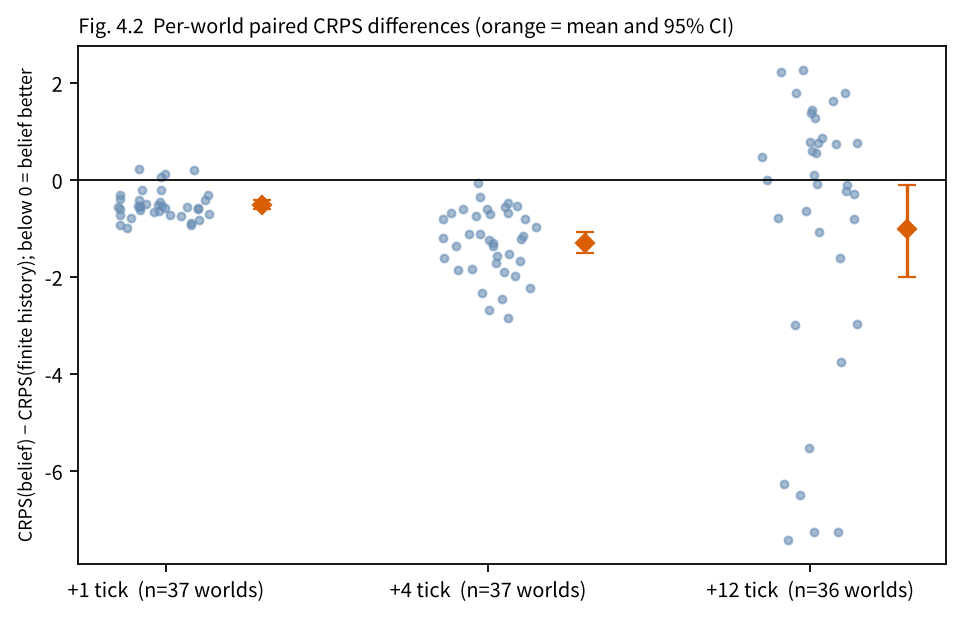
Residents were given a private guess about a child’s hidden food reserve: 12 hypotheses (reserve 0, 1, 3 or 6 × daily drain 1, 2 or 3), updated only from what they could see.
Better forecasts at +1 and +4 ticks in 33/37 and 37/37 worlds. At +12: 19 lower, 17 higher, Holm p = 0.868 — not supported.
All three horizons were required. Two out of three was not allowed to open the next door.
Entry IV, continued
We stopped, as promised
Because the gate failed, no experiment on acting from these beliefs was run. A better forecast is not yet learning to act.
Negative control: two visibly identical children, different hidden stores. One tick later their bodies differed in all 39 pairs, by about 36 energy units on average.
Known defect, unrepaired: 226 of 3,142 delivery receipts were credited to an earlier body record.
Margins
What these pages cannot tell you
- Anything about real people, families, markets or policy.
- Long-run or intergenerational effects — windows are 48 to 480 ticks.
- Independent confirmation: protocols were frozen internally, and no outside group has replicated the simulations.
- A full re-run: the engine, dependency locks and event streams are not distributed.
Protocols were drafted with an AI coding assistant under the project owner’s direction, and the work has not been externally peer reviewed.
The papers keep their negative results: theft (P10), the house (P17), paid manufacture (P18), memory (P19), the +12 gate (P14).
Archive
The evidence drawer
Each study has a data package: frozen protocols, verified aggregate results, per-world rows, analysis scripts and chart data.
- P10-P12Autonomous care338.1 KiB ↓
- P17-P18Tool economics2.29 MiB ↓
- P19Language-model residentswithheld
- P14Bounded beliefs59.8 KiB ↓
CC BY 4.0 for data, figures and documents; MIT for scripts. Check each download against the SHA-256 on the data page.
Open the research data archive →Continue in the papers
“When something social happens, did a resident decide it, or did a rule written by the researcher produce it?”
— Introduction to the SHING CIVITAS research series
Series v3.0 · published 12 November 2026
shingcivitas.com
Drag a corner or use ← → to turn pages · Prefer the formal papers? Start with the introduction →