Article 3·P19·v3.0
When Language-Model Residents Starved More Than Simple Code: Memory, Scarcity and Survival in an Artificial Society
In the food-constrained world, residents controlled by DeepSeek-V4.1-Flash-1017 had lower welfare than both baseline controllers in all 30 worlds; private memory changed plans but not welfare.
SHING CIVITAS Research Series · Article 3 · Study P19 · Version 3.0, bibliography and model-identity revision, 2026-11-12 · Status: published on the SHING CIVITAS website at the owner's direction, 2026-11-12; not externally peer reviewed; third-party contractual risk is disclosed in Section 12
Terms such as tick, world, seed, arm and controller are explained in the introductory article. P19 used the DeepSeek API model deepseek-flash; the provider announced that this alias served DeepSeek-V4.1-Flash-1017 from 2026-10-17. The archived study did not pin an immutable model snapshot.
1. Title and Abstract
Abstract
Language-model agents are often shown planning and remembering in simulated towns, but those demonstrations rarely make plans face hunger and death.
In P19, three adult residents ("focal adults") in each of 60 simulated worlds were controlled, for 180 ticks after a 60-tick warm-up, by one of four controllers: DeepSeek-V4.1-Flash-1017 (API model identifier deepseek-flash) with private memory (llm_mem), the same model without memory (llm_nomem), the learning controller mind9 (m9) and the legacy utility table (old). The two worlds were a food-constrained world (F2a_cap2, food capacity 2) and an abundant world (C, capacity 10), each with 30 paired seeds (19911–19940), giving 240 runs (120 paid). The language model received only what a resident could legitimately perceive and remember, returned short typed plans, and had them validated and executed by the engine. The primary outcome W is the mean energy of the three focal adults across the 180 ticks, with death counted as zero (0–100 scale; it is not a survival percentage). Seven preregistered tests (world = unit; exact sign tests; seed-paired bootstrap 95% intervals; Holm correction) were frozen before the confirmation seeds.
In the constrained world, llm_mem had lower W than m9 (−26.696, 95% CI −31.074 to −22.306) and old (−38.195, −44.177 to −32.327) in all 30 worlds (Holm p = 1.3×10⁻⁸); memory did not improve welfare (llm_mem − llm_nomem +1.813, −0.807 to 4.457; not supported). In the abundant world no comparison was supported. A probe in which memory was removed from the prompt changed the model's plan more often than simple re-sampling did (+0.158, 95% CI 0.096 to 0.221; 60 worlds; Holm p = 6.3×10⁻⁵). Deaths per world in the constrained world were 2.467 (llm_mem), 2.633 (llm_nomem), 1.533 (m9) and 1.033 (old); the dominant cause was starvation.
For this model, prompt, planning interval and action interface, language-model residents allocated actions worse than two simple controllers when food was scarce, and private memory changed plans without improving welfare. The result is specific to this configuration and is not a ranking of language models or a statement about humans.
Keywordslanguage-model agentsartificial societymemoryscarcitysurvivalpaired-seed experiment
2. Research Background
Large language models have been placed in simulated settings in which they plan, remember and interact: a sandbox town of "generative agents" with memory, reflection and planning [1], a fishery commons in which sustainable cooperation varied with the model [2], populations of model agents that develop shared conventions [3], and economic experiments in which a model stands in for a human decision-maker [4]. These studies illustrate what such agents can say and coordinate. A narrower question is whether a plan that reads well also keeps the agent alive when the world enforces hunger, scarcity, fatigue and executable-action rules. Fluent text neither refills an inventory nor reduces hunger.
SHING CIVITAS offers a controlled way to ask this: the same body, the same world snapshot, the same hunger and the same action rules can be given to a language model or to two transparent baselines. mind9 (Introduction, Section 4) is a bounded learner that prices actions by their immediate bodily consequences; the legacy table carries fixed utilities. P19 asks (Q1) how language-model residents compare with these baselines on welfare and survival in scarce and abundant worlds, (Q2) whether private memory changes welfare, and (Q3) whether memory content even enters the decisions.
3. Research Questions and Hypotheses
Seven primary tests were frozen before any confirmation seed was run (Holm correction over all seven). W-tests are two-sided; the memory-probe test is one-sided.
| ID | Hypothesis | Contrast and outcome |
|---|---|---|
| H1 (per world) | Language-model welfare with memory differs from mind9 | W(llm_mem) − W(m9), F2a_cap2 and C |
| H2 (per world) | Language-model welfare with memory differs from the legacy table | W(llm_mem) − W(old), F2a_cap2 and C |
| H3 (per world) | Memory changes welfare | W(llm_mem) − W(llm_nomem), F2a_cap2 and C |
| H4 | Memory content enters decisions | share of plans that change when memory is stripped minus share that change on re-sampling of the same prompt (> 0; 60 worlds pooled) |
Supported requires Holm p < 0.05 and a 95% interval that excludes zero in the same direction. Because the first three are two-sided, no direction was predicted. Secondary, uncorrected descriptions included deaths, time allocation, gathering yield, theft, giving, crafting, cost, latency and validity of the model's plans, plus a distinction between pre-trained knowledge (first plans), within-prompt reasoning (llm_nomem) and learning (differences present only with memory).
4. Research Design
Model provenance. The frozen P19 protocol and report record the API identifier deepseek-flash, non-thinking mode, JSON output, temperature 0.7 and max_tokens=700. DeepSeek's official 2026-10-17 update states that deepseek-flash then routed to DeepSeek-V4.1-Flash-1017 [6]. P19 ran on 2026-11-06; thus this is the model version indicated by the contemporaneous provider release history, not a separately verified immutable model snapshot or returned build hash. The experiment did not test DeepSeek V4 Pro, the untested proposed follow-up model. This is an independent research comparison and does not claim provider endorsement.
Worlds. F2a_cap2 (constrained; food capacity 2; mind9 elsewhere) and C (abundant; capacity 10; in P18, paying to craft was harmful and the carry limit made a tool's gain zero). Confirmation seeds 19911–19940 give 30 paired seeds per world, 60 worlds. For every world, a snapshot at tick 60 served all four arms; the focal residents were the three healthy adults with the smallest IDs at tick 60. The observation window is ticks 60–240 (180 ticks, the larger part of two winters).
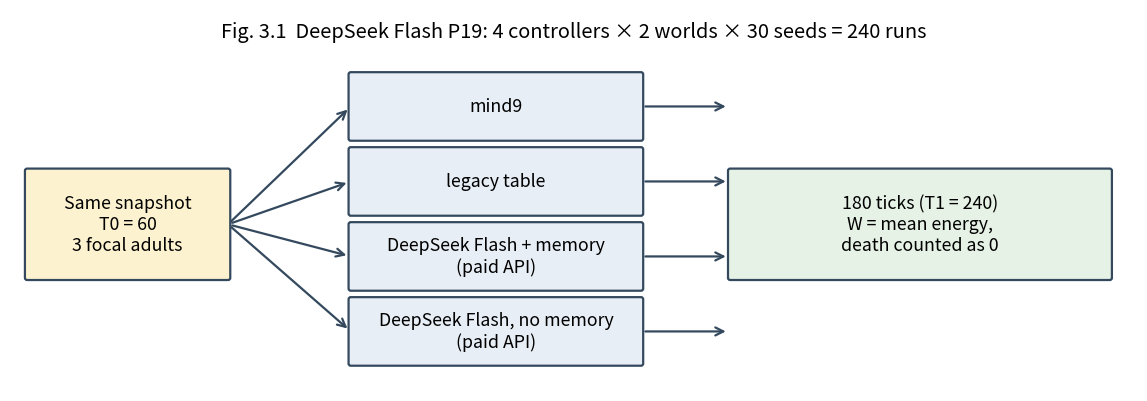
Controllers. m9 and old (free; verified against twin worlds). The language-model arms use DeepSeek-V4.1-Flash-1017, called through the API model ID deepseek-flash with thinking mode off, JSON output, temperature 0.7 and an output limit of 700 tokens. Instead of one call per tick, each call returns a typed plan of up to eight steps (about 12 ticks). The world validates each step at execution time and calls the model again when a plan ends, a step is infeasible, the resident is robbed, becomes ill or recovers, energy falls below 25, or a tool wears out. The model decides what to do, to whom, how much and where: go{x,y} to a remembered tile (gathering happens on the tile where the resident stands), approach, give{to, amount}, socialize, steal. Consequences (detection, trust, punishment, accounting) are applied by the engine.
Legal view. The prompt contains only: the resident's body, inventory and tools; the tiles it remembers (with observation times; possibly outdated); people in view with their visible energy level; its own trust values and family; events that happened to it (a thief not seen stays anonymous); and the calendar. It contains no other resident's inventory, traits or thoughts and no global map. Action descriptions give syntax and preconditions ("3 wood → tool") but not effect sizes.
Memory manipulation. llm_mem keeps its own notes (at most six), goals, the outcomes of its last ten steps, and a table of its own gathering results with and without a tool. llm_nomem has all memory removed and sees only events of the last six ticks.
Memory probe. For each llm_mem run, four decisions that already contained the resident's own experience were asked again twice: once with the same prompt (re-sampling) and once with memory stripped. The difference in the share of plans whose action set changed estimates how much memory content, rather than sampling noise, enters the decision (60 paired worlds).
Verification. Every paid run was replayed offline from the logged responses; the state hash had to match at every tick (120 of 120 did).
Development history (disclosed). Development seeds 19901/19902 were used before the confirmation seeds. In the first development run all three model residents starved (ticks 101, 113 and 140) in a snapshot where mind9 and the legacy table kept 3 of 3 alive. Two defects in the prompt and memory, not in the world, were found and fixed before the confirmation seeds: the prompt had stated an incorrect rule that a resident automatically eats a portion when energy is below 75 (the engine eats only whole portions, so a resident with less than one portion cannot eat), and the memory recorded only food and wood changes without the energy, fatigue and sleep-pressure consequences of each action. Tool effects were deliberately not described. The confirmation results therefore reflect the repaired prompt; the failure of the first prompt is evidence about prompt sensitivity.
5. Variables and Operationalization
| Variable | Role | Operational definition | Unit |
|---|---|---|---|
| Controller arm | Independent | m9, old, llm_mem, llm_nomem | categorical |
| World condition | Independent | F2a_cap2 (constrained) vs C (abundant) | categorical |
| W (focal welfare) | Primary dependent | Σ focal energy ÷ (3 residents × 180 ticks); death counts as 0 | energy units, 0–100 |
| Deaths per world; starvation deaths | Secondary | Focal deaths (all causes; starvation only, recorded separately from the age/disease hazard) | deaths per world (3 focal adults) |
| Alive person-ticks | Secondary | Focal resident-ticks alive | person-ticks per arm |
| Time allocation | Secondary | Share of focal resident-ticks per action class (forage, sleep, go, chop, etc.) | proportion |
| Gathering yield | Secondary | Food per forage action | food units per action |
| Plan-change rate (probe) | Primary (H4) | Share of re-asked decisions whose planned action set changed | proportion |
| Requests, cost | Descriptive | Requests logged; cost at archived peak price | count; USD |
| Controls | Fixed | Same snapshot and focal residents per world; same action interface; 180 ticks | — |
6. Sample and Experimental Units
30 paired seeds (19911–19940) × 2 worlds × 4 arms = 240 runs (120 paid). Each run has three focal adults, so 360 paid and 720 total focal-resident instances; these instances and the 180 ticks are nested repeated measures and are not independent samples. The unit of inference is the paired world (n = 30 per world condition; 60 for the probe, which pools both). No run was excluded; all 120 paid runs replayed identically. Development seeds 19901 and 19902 are outside the confirmation set.
7. Methods and Statistical Analysis
For each world the paired difference of W between two arms was computed. We report the mean difference (energy units), a 95% percentile bootstrap interval (10,000 resamples of worlds), the exact two-sided sign test (zeros dropped) and Holm-adjusted p over the seven frozen tests; the probe uses a one-sided sign test on the paired plan-change difference. W is bounded and includes zeros for dead residents, so the mean mixes survival and energy of the living. "Supported" required Holm p < 0.05 and an interval excluding zero. Secondary quantities (deaths, time budget, yield) are descriptive and uncorrected.
8. Results
8.1 Welfare (W)
Table 3.1. Mean W by arm and world (energy units, 0–100; 30 worlds per cell; descriptive).
| Arm | Constrained (F2a_cap2) | Abundant (C) |
|---|---|---|
| llm_mem | 24.926 | 75.803 |
| llm_nomem | 23.113 | 76.471 |
| m9 | 51.622 | 78.023 |
| old | 63.121 | 73.393 |
Table 3.2. P19 primary tests (n = 30 paired worlds each, probe n = 60; Holm over seven).
| Test | Contrast | Mean difference | 95% CI | Sign test p | Holm p | Supported |
|---|---|---|---|---|---|---|
| H1, constrained | llm_mem − m9 | −26.696 | [−31.074, −22.306] | 1.86×10⁻⁹ | 1.30×10⁻⁸ | Yes |
| H2, constrained | llm_mem − old | −38.195 | [−44.177, −32.327] | 1.86×10⁻⁹ | 1.30×10⁻⁸ | Yes |
| H3, constrained | llm_mem − llm_nomem | +1.813 | [−0.807, 4.457] | 0.200 | 0.802 | No |
| H1, abundant | llm_mem − m9 | −2.219 | [−3.965, −0.717] | 0.362 | 1 | No |
| H2, abundant | llm_mem − old | +2.410 | [−0.159, 5.014] | 0.585 | 1 | No |
| H3, abundant | llm_mem − llm_nomem | −0.668 | [−2.298, 0.824] | 1 | 1 | No |
| H4, probe | stripped − resampled plan-change rate | +0.158 | [0.096, 0.221] | 1.27×10⁻⁵ | 6.33×10⁻⁵ | Yes |
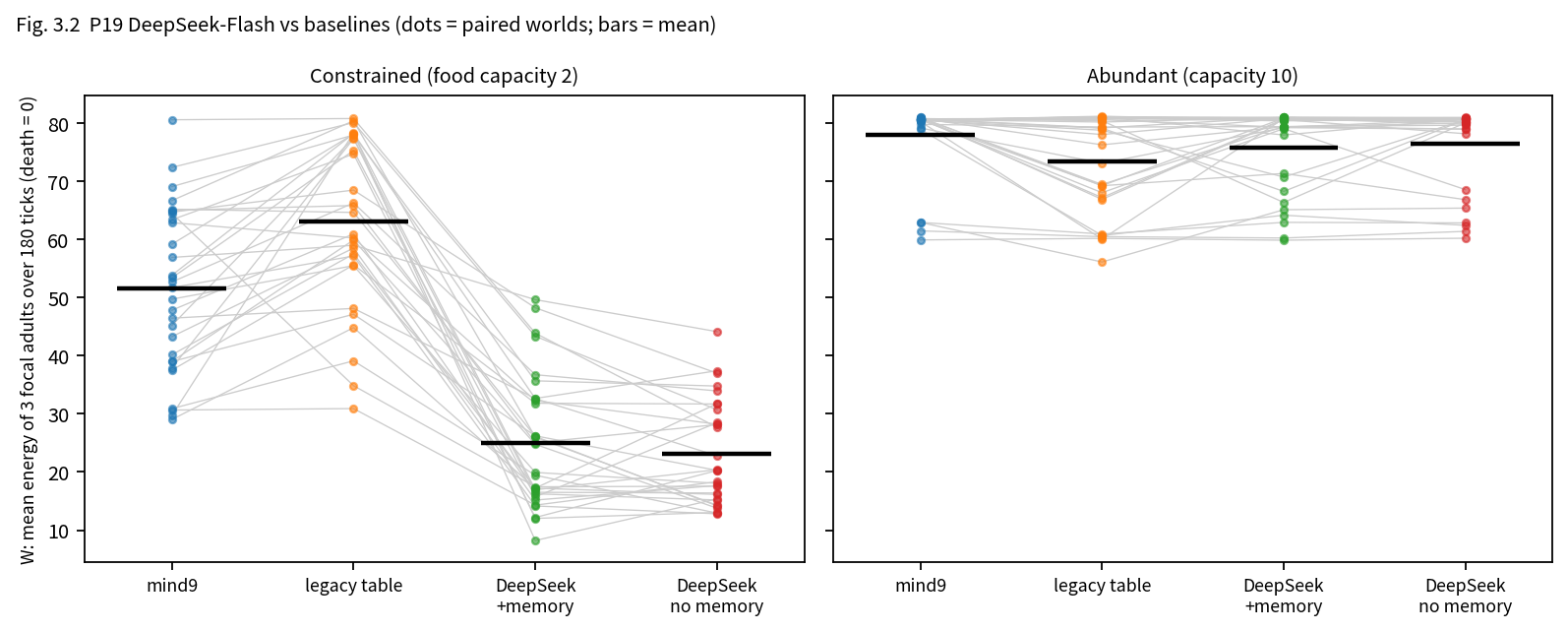
Reading. H1 and H2 (constrained): in all 30 worlds, the model-controlled residents' mean energy (death = 0) was lower than under mind9 and under the legacy table, by about 27 and 38 energy units on a 0–100 scale; the intervals are far from zero and the sign test is unanimous (0 of 30 in favour of the language model). H3: with versus without memory the difference was small, positive and its interval spans zero, so memory did not demonstrably affect welfare. Abundant world: the intervals are mostly around zero; for H1 the interval (−3.965 to −0.717) excludes zero but the sign test does not reach significance after correction, so under the frozen rule it is not supported; a mean difference of about 2 energy units is small compared with the constrained-world gap. H4: removing memory changed the model's plan about 16 percentage points more often than re-sampling did (34 worlds higher, 7 lower; remaining worlds tied), so memory content entered the decision process. It does not show that welfare improved or that the model learned a causal rule from experience.
8.2 Deaths
Table 3.3. Deaths per world (3 focal adults per world; 30 worlds per cell; descriptive).
| Arm | World | All-cause deaths | Starvation deaths | Age/disease deaths | Focal alive at end (of 90) |
|---|---|---|---|---|---|
| llm_mem | constrained | 2.467 (74 total) | 2.400 (72) | 0.067 (2) | 16 |
| llm_nomem | constrained | 2.633 (79) | 2.467 (74) | 0.167 (5) | 11 |
| m9 | constrained | 1.533 (46) | 1.400 (42) | 0.133 (4) | 44 |
| old | constrained | 1.033 (31) | 0.867 (26) | 0.167 (5) | 59 |
| llm_mem | abundant | 0.367 (11) | 0.200 (6) | 0.167 (5) | 79 |
| llm_nomem | abundant | 0.300 (9) | 0.133 (4) | 0.167 (5) | 81 |
| m9 | abundant | 0.200 (6) | 0.033 (1) | 0.167 (5) | 84 |
| old | abundant | 0.600 (18) | 0.467 (14) | 0.133 (4) | 72 |
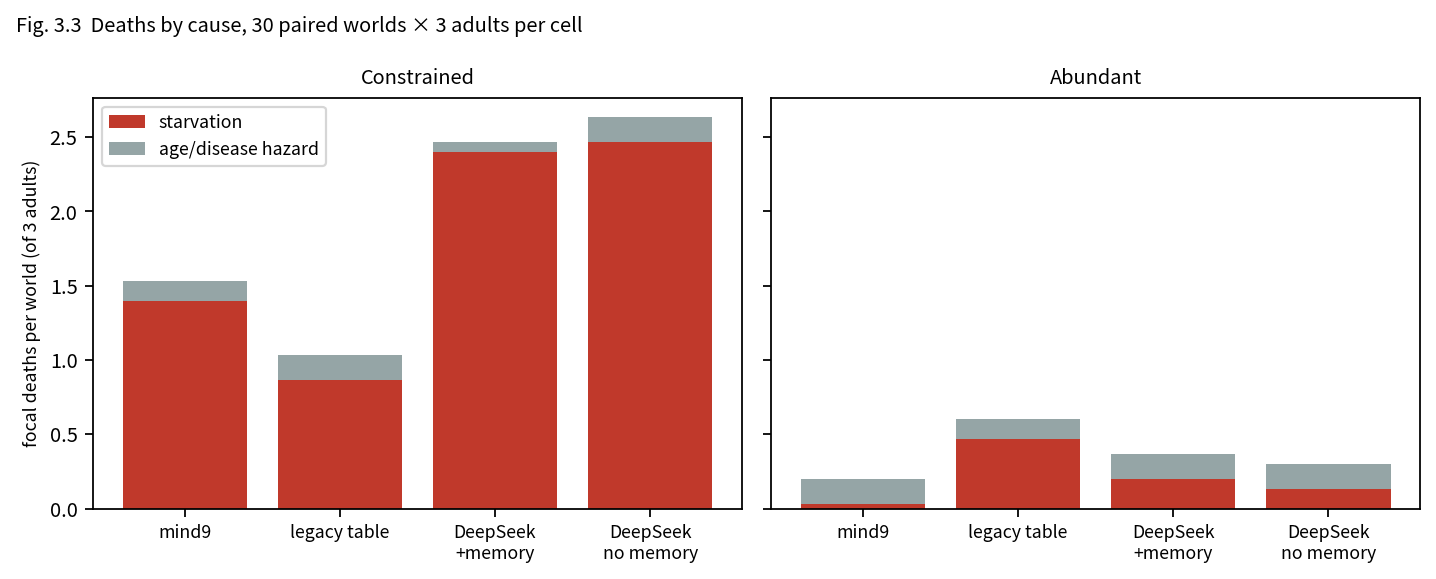
Reading. With three focal adults per world, 2.467 deaths per world means that on average about 82% of focal adults with the language model with memory died within 180 ticks in the constrained world (74 of 90), versus 51% with mind9 and 34% with the legacy table. The first written summary of this study reported "2.5 starving residents per world", which mixed denominators; separate totals (85 deaths, 78 starvation deaths) that aggregate llm_mem over both worlds (180 focal adults) must not be divided by the constrained cohort alone, and a figure of "about 2.3 starvation deaths per world" is withdrawn. Mortality in the abundant world is low for all arms; the legacy table has the most deaths there (18, of which 14 starvation), which is descriptive only.
8.3 What did the residents do? (exploratory decomposition)
Table 3.4. Time and yield in the constrained world (share of focal resident-ticks; food units per forage action; descriptive).
| Arm | Foraging | Sleeping | Moving (go) | Food per forage action |
|---|---|---|---|---|
| llm_mem | 0.386 | 0.316 | 0.204 | 0.491 |
| llm_nomem | 0.373 | 0.252 | 0.239 | 0.504 |
| m9 | 0.695 | 0.247 | — | 0.423 |
| old | 0.536 | 0.214 | — | 0.546 |
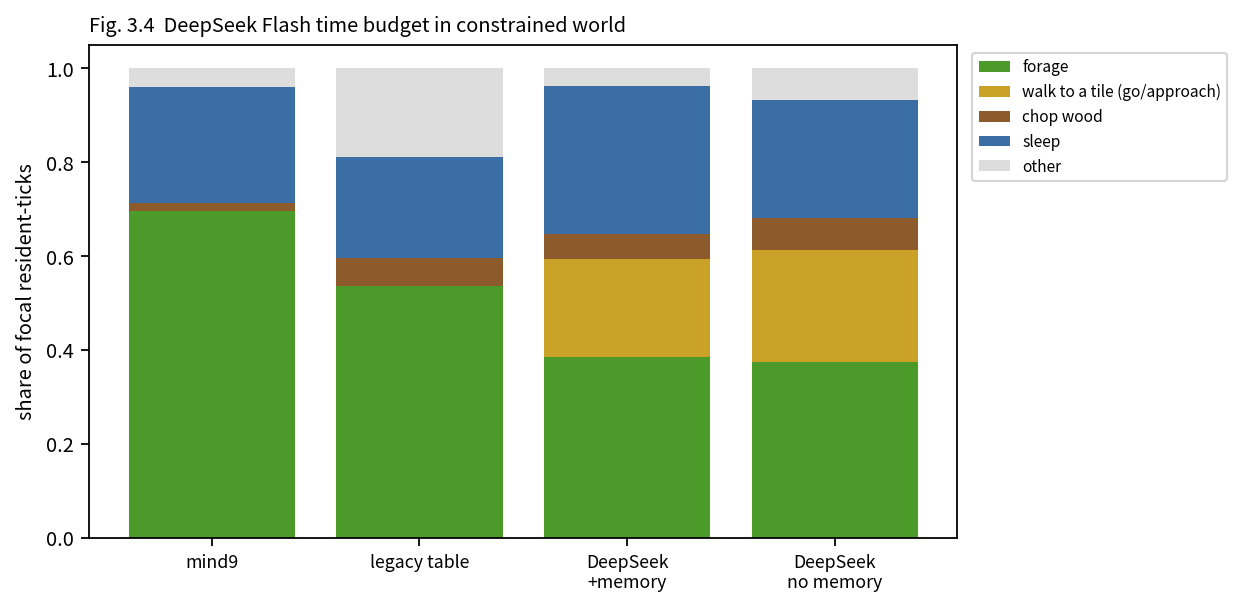
Language-model residents spent about 37–39% of their ticks foraging, compared with about 70% for mind9, while spending a fifth to a quarter of their ticks moving between tiles; per forage action, their yield (0.49–0.50 food units) was not lower than mind9's (0.42). A plausible account is that the welfare gap stems from allocation of time, not from inability to gather. Time allocation was not randomized, so this is a hypothesis, not a demonstrated cause; the decomposition file has no go entry for m9 and old, so those cells are left blank. Smaller effects were also recorded: residents of the language-model arms rarely stole and sometimes gave food or stored wood; these socially appealing actions did not translate into better survival.
8.4 Validity, cost and execution
All 8,034 requests (8,029 successful, 5 failed) were logged, at an estimated USD 2.833641 under archived peak-price accounting (not a verified provider invoice). 120 of 120 paid runs replayed with identical per-tick state hashes. 591 plan steps were infeasible when executed and were rejected by the executor. The original protocol capped requests at 200 and cost at USD 5; before the confirmation seeds were run the project owner removed the cost ceiling, the multi-world protocol (v2) was frozen without it, and the actual number of requests far exceeded 200. This is a disclosed deviation from the pilot-stage protocol, not from the frozen confirmatory protocol.
9. Discussion
What is shown. Under scarcity, residents driven by a language model, given only a legitimate view of the world and typed-plan actions, lost more of their welfare than residents driven by either baseline, and did so in every one of 30 worlds. Under abundance, differences were small and within noise. The result is therefore a statement about an interaction between a world's scarcity and a decision process's action allocation: when mistakes are cheap, plans are good enough; when food is scarce and each tick matters, allocation matters.
Memory. The probe shows that the memory block was used. The welfare comparison shows that its use, in this implementation, did not translate into measurable gain. This is consistent with several accounts that the data cannot separate: the memory content may not be informative enough, the model may not draw correct conclusions from it, or the benefits may be too small to detect with 30 worlds (interval −0.8 to +4.5).
Prompt sensitivity. The development history is informative in its own right: a single false sentence in the prompt about when a resident eats, and the absence of bodily consequences from memory, both contributed to early deaths. Results from language-model agents in simulation should be read as results about a model-plus-prompt-plus-interface system.
Relation to prior work. Earlier language-model simulations report fluent planning and social coordination [1–3]; P19 adds a case where the same kind of agent is poorly matched to a hard survival economy. It should not be read as contradicting those studies, which used different tasks, models and success criteria.
10. Limitations
- One model, one prompt, one planning cadence, one interface; results are not a ranking of language models and may not hold for other models, versions or prompts. The prompt was repaired after development failures.
- Three focal adults per run; other residents are mind9. Nested measures are not independent.
- Time allocation is not randomized; the mechanism in Section 8.3 is a plausible, not proven, cause.
- Memory design is one implementation; a null welfare effect does not show memory is useless.
- W conflates survival and energy.
- Abundant-world comparisons: the H1 interval excludes zero while the sign test does not; reported as not supported by the frozen rule.
- Cost figures are estimates at archived peak pricing, not invoices; the cost ceiling was lifted by the owner before confirmation.
- Single time window (180 ticks); no long-run or intergenerational inference.
- Replication is offline only: recorded model responses can be replayed, but the model cannot be re-queried by third parties from the package; raw prompts and event streams are excluded.
- Rights and governance: the existing dataset manifest still marks P19
PUBLICATION_BLOCKED; the owner has asked to publish the article despite unresolved provider contract interpretation, and the record must be reconciled before public data download; preregistration was internal; protocols were drafted with an AI coding assistant under the owner's direction (wording to be confirmed by the owner); no independent replication.
11. Conclusion
In this artificial society, language-model-controlled residents were much less welfare-efficient than a bounded learner or a hand-written utility table when food was scarce (about 27 and 38 energy units lower on a 0–100 scale, in all 30 worlds), and were comparable when food was abundant. Private memory visibly changed the model's plans but did not measurably change welfare. The conclusion is limited to the configuration studied: a coherent plan is not a sufficient condition for survival in this world, and the allocation of limited time and actions, not fluency, is where the gap appeared.
12. Data Availability and Reproducibility
The evidence package SC-P19-LLM-Residents contains the protocol, report and a mortality-correction note, per-run derived records for the 240 runs (numeric IDs, no prompt text), the public analysis and decomposition JSON, primary-result and mortality CSVs, the API usage summary and release metadata. Raw prompts and responses, complete event streams and credentials are excluded. All numbers in this article were recomputed from the per-run records (Tables 3.1–3.3) and the frozen analysis files (Tables 3.2 and 3.4) and match. The archived ZIP still carries PUBLICATION_BLOCKED in its original release metadata: this v3 article does not change that ZIP or the manifest. The owner has instructed that P19 be included in the planned publication despite an unresolved contractual concern over naming the provider. Public availability of the ZIP requires a separate, explicit publication action and a consistent updated release record; this editorial ZIP alone contains no public dataset URL. Because the simulation engine, model snapshots and recorded raw responses are not distributed, neither the simulations nor the model calls can be re-run from the package. Names inside the package still use the earlier name "Emergentia", and the package's protocol, report and metadata name the provider and model, which are retained for research provenance; the owner has directed disclosure, while the unresolved contractual risk must remain documented.
SHING CIVITAS P19 LLM Residents Dataset
SHING CIVITAS P19 LLM 居民研究数据集
Experiment in which a third-party language model continuously controlled focal adult residents in simulated worlds: frozen protocol, verified statistics, per-run cohort table, aggregated API usage, analysis scripts and an original figure, with a mortality correction note. Contains no model prompts, model responses or raw API ledgers.
Download withheld. This dataset (P19) is undergoing a third-party rights review and is not available for download. If the review is cleared, it will be provided here with licence and citation information.
Reason recorded by the release audit: The third-party model provider's open-platform terms forbid, without permission, any use of its trademarks, trade names or prominent brand features, expressly including its name (clause 5.2), and make such breach a fundamental breach (clause 5.4). This package names the model and provider 37 times in text files (README, environment notes, one analysis script and the protocol documents) and twice in a figure label rendered into the PNG. No written permission obtained. No verbatim model output, prompts or API ledgers are included. Data integrity and security checks passed; the block is a rights issue, not a quality issue.
References
Publication records, publisher pages and DOI metadata were checked on 2026-11-12. These external works support the theoretical or methodological background, not any SHING CIVITAS result.
- 1Park, J. S., O’Brien, J. C., Cai, C. J., Morris, M. R., Liang, P., & Bernstein, M. S. (2023). Generative agents: Interactive simulacra of human behavior. Proceedings of UIST ’23, Article 2, 1–22. https://doi.org/10.1145/3586183.3606763
- 2Piatti, G., Jin, Z., Kleiman-Weiner, M., Schölkopf, B., Sachan, M., & Mihalcea, R. (2024). Cooperate or collapse: Emergence of sustainable cooperation in a society of LLM agents. Advances in Neural Information Processing Systems 37 (NeurIPS 2024). https://proceedings.neurips.cc/paper_files/paper/2024/hash/ca9567d8ef6b2ea2da0d7eed57b933ee-Abstract-Conference.html
- 3Ashery, A. F., Aiello, L. M., & Baronchelli, A. (2025). Emergent social conventions and collective bias in LLM populations. Science Advances, 11(20), eadu9368. https://doi.org/10.1126/sciadv.adu9368
- 4Horton, J. J., Filippas, A., & Manning, B. S. (2023; revised 2026). Large language models as simulated economic agents: What can we learn from Homo silicus? NBER Working Paper No. 31122. https://doi.org/10.3386/w31122
- 5Holm, S. (1979). A simple sequentially rejective multiple test procedure. Scandinavian Journal of Statistics, 6(2), 65–70. https://www.jstor.org/stable/4615733
- 6DeepSeek. (2026, October 17). DeepSeek-V4.1-Flash-1017 model update (API alias
deepseek-flash). DeepSeek API change log. https://api-docs.deepseek.com/updates/
Verification register: See Appendix C · Reference register for source links, bibliographic corrections and scope.