Introduction·v3.0
SHING CIVITAS: An Experimental Platform for Studying Autonomous Agents in a Simulated Society
How the artificial society works; what tick, world, seed, arm and fork mean; how experiments are designed and analysed; and what they can and cannot show.
SHING CIVITAS Research Series · Introduction · Version 3.0 (verified references, 2026-11-12) · Status: published on the SHING CIVITAS website, 2026-11-12; not externally peer reviewed
Summary. SHING CIVITAS is an independent research project that builds a small artificial society and uses it as a laboratory. Software residents must find food, survive winters, raise children, trade, sometimes steal, and decide whether to help one another. Because a researcher can copy the world at any moment, change one rule, and run both versions forward, the platform can ask a question that is hard to answer by watching: when something social happens, did a resident decide it, or did a rule written by the researcher produce it? This article explains how the society works, what the main technical terms mean (tick, world, seed, controller, run, arm, fork), how experiments are designed and analysed, and what such experiments can and cannot tell us. The four research articles in this series (autonomous care, tool economics, language-model residents, bounded beliefs) can each be read alone, but they all rely on the vocabulary introduced here.
Reading guide. Sections 1–2 give the motivation and research questions. Sections 3–5 describe the simulated world, the residents, and the controllers that decide for them. Sections 6–9 describe the experimental method and statistics. Section 10 lists limitations. Section 11 summarizes the four studies. Section 12 gives data availability and references.
1. Why build an artificial society?
When researchers watch a simulated village in which children are fed, tools are made, or houses are built, it is tempting to say that care, craft or cooperation has "emerged." That claim hides a question. In many simulations the world engine itself moves food between family members, punishes thieves, or assigns trust. If the engine does the work, the outcome tells us about the engine, not about the residents' decisions.
Agent-based modelling has a long tradition of using artificial societies to examine how social patterns arise from local rules: Schelling's segregation model [1], Epstein and Axtell's Growing Artificial Societies [2], and Axelrod's studies of cooperation [3] are classic examples, and Epstein has argued that such models are most valuable as tools for explanation and for asking "what must be true for this pattern to appear" [4]. More recently, language-model agents have been placed in simulated towns and commons [5–8], which raises a fresh question: do such agents behave sensibly when their choices have real, accountable consequences such as hunger, cold, and death?
SHING CIVITAS takes a deliberately narrow position within this literature. It does not try to reproduce any real human society. It asks about attribution and minimal conditions:
- Which social outcomes are produced by rules the researcher wrote, and which by decisions the residents make?
- What information must a resident legitimately possess, and what must the world physically offer, before an action such as caring for a child, making a tool, or saving food becomes both possible and worthwhile?
- How do simple, transparent decision systems compare with a general-purpose language model placed in the same body and the same hunger?
2. Research questions
The studies reported in this series address these questions in a staged way. Each stage was designed after reading the previous one, and later stages explicitly retract interpretations that earlier ones could not support.
| Stage | Question | Article |
|---|---|---|
| P10–P12 | If the engine stops moving food to children automatically, do residents take over? Where in the decision chain does care break down? Does one act of care change a child's fate? | Article 1 (autonomous care) |
| P17–P18 | Under what physical conditions do tools, houses, reserves, mutual aid and exchange have real value? Is a tool that is useful also worth making? | Article 2 (tool economics) |
| P19 | If a general language model controls adult residents under the same hunger and rules, how does it compare with the platform's own controllers? Does private memory help? | Article 3 (language-model residents) |
| P14 | Can residents hold bounded private beliefs about a child's hidden food reserve and predict the child's condition better than simpler rules? Does better prediction justify moving to action? | Article 4 (bounded beliefs) |
The "P" numbers are the project's internal sequence numbers for experiments. Earlier experiments (P1–P9) and several intermediate ones (P13, P15, P16) are referred to when needed, but only the data for P10–P12, P14, P16-A/B, P17–P18 and P19 were available when these articles were prepared (Section 12).
3. The simulated world
3.1 Space, time and resources
The world is a grid of tiles. Each tile holds food and wood, which regrow slowly up to a per-tile capacity. In the standard research world the food capacity is 10 units per tile; a "constrained" world sets it to 2 (one of the main experimental manipulations). Terrain includes forest and plains with different endowments.
Time advances in discrete steps called ticks. One tick represents four model hours, so six ticks make a model day. The project also uses a compressed calendar: 120 ticks (20 model days) form a model year, of which the last 30 ticks are winter. A standard experimental run lasts 480 ticks, or four model years. A child needs about 1,680 ticks to reach adulthood, so no experiment in this series follows a generation to maturity.
3.2 Bodies and survival needs
Every resident has an energy level between 0 and 100. Each tick, a body burns energy (about 3 units for an adult; children's burn depends on age). One unit of food supplies 12 energy. A resident eats a whole portion from its own inventory when energy falls below 75; fractions of a portion cannot be eaten. A resident dies of starvation when energy is exhausted, or of an age-or-disease hazard, which the engine applies at random. These are recorded as different causes of death, and the articles never merge them.
Winter (the last 30 ticks of each model year) raises survival pressure; houses and wood use are treated in Article 2. Residents get fatigued by work and need rest or sleep. Carrying capacity is limited (20 units in the standard research world), and carried food spoils slowly. Labour costs energy.
Residents fall into three groups used in the analyses: healthy adults, ill adults, and children. By a world rule, children cannot gather food themselves; their survival depends on adults.
3.3 Tools, buildings, trade and storage
Wood can be used for winter heating, construction, trade, or to craft a tool. A tool costs three wood and one crafting action; it multiplies the yield of each harvesting action by about 1.5 (the gain is truncated by what the tile holds and by the carrying limit) and wears out after about 80 harvesting actions, one unit of durability per action regardless of yield. Residents can also start building projects (for example, houses that reduce winter exposure), barter goods, use a cash market, post offers, and form households and partnerships.
3.4 Social structure and institutional rules
Residents belong to families and households, form partnerships, have children, and build trust in one another through direct experience, witnessing and gossip. The world also contains rules that act without anyone deciding. These matter greatly for the research questions, so the engine marks them explicitly:
- Automatic household sharing. In the legacy configuration, at every tick the engine moves food among family members who are in the same place.
- Automatic peer punishment. Residents with a punishing disposition punish thieves with some probability; the punisher does not choose.
- Trust updates, partnership and birth probabilities, inheritance and orphan adoption.
By contrast, caring (giving food to a dependant), sharing, socializing, barter, theft, crafting and building are actions a resident's controller can choose. An experiment can switch an automatic rule off, which is the main way P10 isolates what residents actually decide.
Some other mechanisms (for example, a "mutual aid institution" and a market) are treated in Article 2.
4. Residents and how they decide
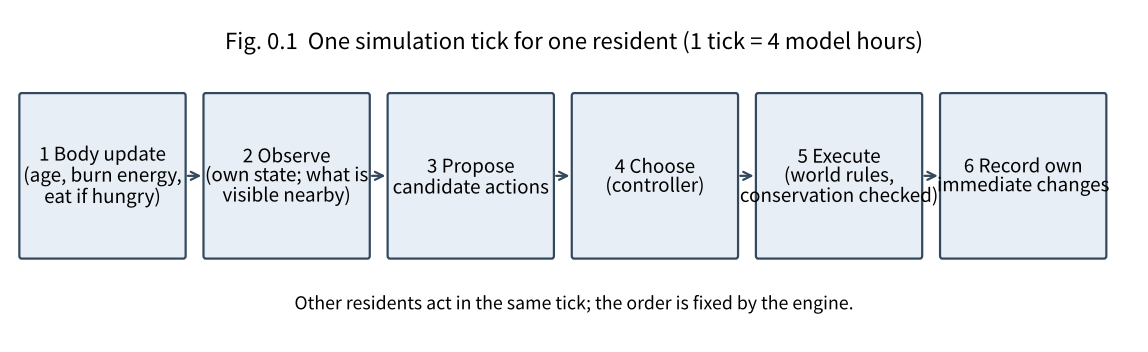
An agent here is a simulated resident with a body, an inventory, a memory of what it has seen, relationships, and a controller that chooses actions. A resident's turn within a tick follows the cycle in Figure 0.1: the body is updated, the resident observes, candidate actions are proposed, the controller chooses one, the world executes it under its rules (with food and wood conservation checked every tick), and the resident records the immediate bodily changes its action caused.
4.1 What a resident may know
A central design principle is a legal view: a resident's decision may use only information a person in that position could plausibly have. For example, an adult deciding whether to feed a child may use the child's visible condition and position within sight, but not the child's hidden food inventory. Much of the early work in this series consisted of finding places where inherited code violated this principle, and then testing what changed when it was repaired (Article 1 and Article 4). The platform's authors state plainly that the legal view is currently enforced only along specific pathways, such as the care pathway introduced in P12, and not across the whole agent.
4.2 The three kinds of controller
- The legacy table ("old"). A hand-written utility table assigns fixed values to actions (for instance a large value to caring for a child, and a preference to craft when wood allows). It produces plausible social behavior, but the behavior is written in, so it cannot show that a resident discovered it.
- mind9 ("unified"). A small learning decision system. It prices each candidate action by the immediate changes to its own energy, food, wood, fatigue and the like that it has previously experienced, plus a set of cultural priors. It examines at most three candidates, ordered by familiarity and current need, stops when one looks good enough (satisficing [9]), and takes a random exploratory action about 5% of the time. Actions it has never tried have, by default, a value of zero. Because it learns only from same-tick bodily changes, a delayed or other-directed benefit, such as the long-run value of a tool or a child's later survival, is invisible to it. This is an engineered, deliberately limited model, not a claim about human cognition.
- A language-model controller (P19). A general-purpose large language model receives a text description of what the resident can legitimately see and remember, returns a short typed plan, and the engine validates and executes each step (Article 3).
Experimental "treatments" can also modify mind9, for example by adding a cue that raises a visibly weak dependant in the resident's attention, or by assigning an aspiration-level value to untried actions instead of zero (Article 1), or by adding a private belief store (Article 4).
5. The vocabulary of an experiment
| Term | Meaning in SHING CIVITAS |
|---|---|
| Seed | An integer that fixes the random number stream and therefore the initial world: map, residents, families, and the sequence of random events that are not otherwise affected. Different seeds give different but statistically comparable worlds. |
| World | One concrete simulated society produced by a seed under one configuration. "40 worlds" means 40 separate simulated societies. |
| Arm | One experimental condition (for example "automatic sharing off, mind9"). Each seed is typically run once under every arm. |
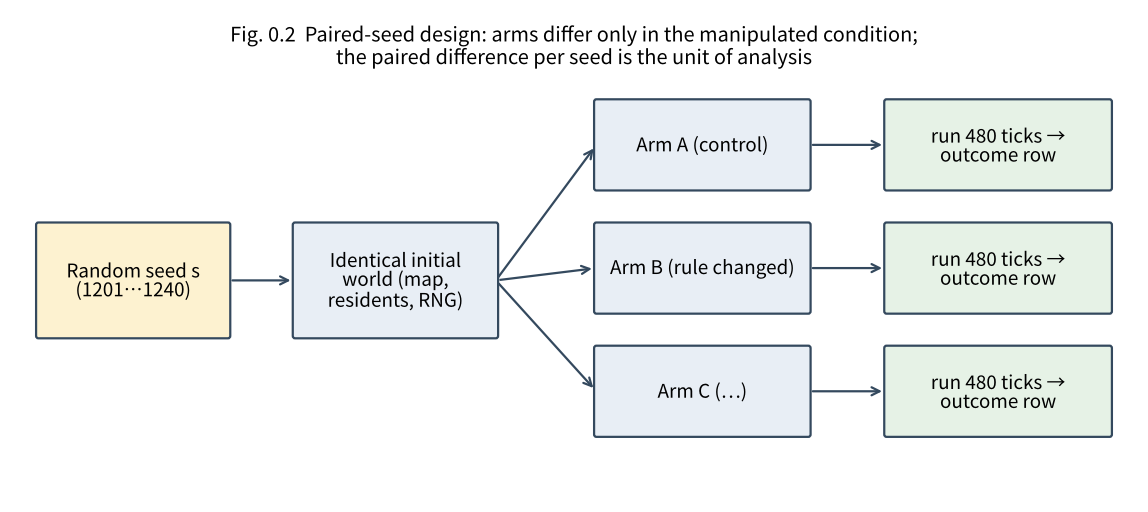
| Paired seeds | The same seed run under several arms. All arms start from the identical initial world, so differences are attributable to the arm (plus whatever changes downstream because of it). |
| Controller | The decision system that picks a resident's actions: the legacy table, mind9, or a language-model controller. |
| Run | One execution of a world under one arm or controller from start to end. In P19, a "run" is also the unit that records the controller's decisions. |
| Snapshot and fork | A complete saved state of a world at a given tick. A fork resumes two or more copies from one snapshot with one thing changed (for example, an adult forced to care versus to rest). |
| Warm-up | The period before an intervention so that the world reaches a representative state (T0 = 60 ticks in P17–P19). |
| Development, pilot and confirmation seeds | Disjoint seed ranges. Development seeds are used to build and debug; they are seen and discarded. Pilot seeds check for technical faults. Confirmation seeds supply the reported inference; their results are not inspected before the protocol is frozen. |
| Person-tick | One resident alive for one tick. "Alive person-ticks" are a welfare measure that counts both who survives and how long. |
6. How researchers manipulate the world
The platform supports four families of manipulation, each used in the series:
- Rule switches. Turn an automatic rule on or off (household sharing, punishment, punishment strength).
- World parameters. Change food capacity, the number of residents, regrowth, spatial endowment, or the variability of rain-driven shocks.
- Cognitive and informational treatments. Add attention cues, change how untried actions are valued, change what a resident may observe, or add a private belief store.
- Researcher interventions at a snapshot (forks). Give a tool or a house, top up food, remove an institution, or force a single action. These forks are not decisions of the residents. They measure the objective consequences of a condition ("what is a tool worth?") separately from whether a resident would choose it.
The distinction between these is essential. A result of the form "a free tool raises survival" says nothing about whether residents would make or acquire one; the latter needs its own experiment, and Article 2 shows the two can disagree.
7. Experimental design and the logic of comparison
7.1 Frozen protocols
For each study, a protocol that states the hypotheses, arms, seeds, outcomes and decision rule was written and saved in version control before the confirmation seeds were run. We call this internal preregistration. Because the version-control history is private and the protocols were not deposited with a public registry, the freeze dates cannot currently be checked by an outsider (Section 10). The protocols themselves allow later "revision" entries, but revisions are appended and dated, and the series reports any revision made after a pilot.
The articles distinguish three evidence classes:
- Confirmatory (preregistered primary): a hypothesis, outcome and rule frozen before the confirmation run, with a correction for multiple tests.
- Secondary (pre-specified, uncorrected): listed in the protocol but outside the corrected family. Reported with uncertainty, never as discoveries.
- Exploratory or post hoc: defined or noticed after seeing results. Labelled as such, and used only to generate questions.
7.2 Independence and sample sizes
The unit of inference is the world (seed). Residents within a world, actions within a resident, and ticks within a run are strongly dependent, so counting them as independent samples would greatly overstate certainty. Every article states the number of independent worlds, which is 30 to 40 per comparison here. Counts of actions, predictions or deaths are reported as descriptive totals and are never used as sample sizes.
Forty worlds is a modest sample. The protocols note that it detects only large, consistent effects at strict thresholds, and that a non-significant result is not evidence of equivalence.
7.3 Seed pairing
Because all arms of one seed start from an identical world, comparing arms within a seed removes much of the variation in map and population that would otherwise obscure the effect. This is the simulation analogue of a paired design, or of "common random numbers" in simulation methodology [10]. The pairing is not perfect: after the treatment alters events, random streams can drift, so arms diverge for reasons beyond the treatment's direct effect. The articles describe results as total effects of a manipulation in this model (including downstream behavioral adaptation), not as isolated mechanisms.
8. Statistical analysis
All analyses use the paired differences per world. The common toolkit is as follows.
Effect size. The mean paired difference between a treated arm and its control arm, in the natural unit of the outcome (deaths per world, transfers per world, energy units, person-ticks), together with counts of worlds in which the difference was positive, zero or negative. These counts make the "consistency" of an effect visible even when a mean is dominated by a few extreme worlds.
Confidence intervals. A 95% interval from a seed-paired percentile bootstrap: worlds are resampled with replacement 10,000 times (5,000 for the care-versus-rest forks) from a fixed random generator, and the 2.5th and 97.5th percentiles of the resampled means are used [11]. An interval that excludes zero indicates that, under this resampling, the mean difference is distinguishable from zero. It is not a probability statement about the true effect, and it relies on the 30–40 worlds being representative of the population of worlds the simulator can generate.
Significance test. An exact sign test on the non-zero paired differences [12]. It asks how surprising the split of positive and negative worlds would be if each direction were equally likely. Its strength is that it makes no distributional assumption and is robust to outliers; its weakness is that it ignores the size of differences, and worlds with zero difference carry no weight. Whether a primary test is one-sided (a directional prediction frozen in the protocol) or two-sided differs between studies; the frozen P17–P18 primary families use one-sided exact sign tests, and each article states which test applies.
Multiple comparisons. Within each frozen family of primary tests, p-values are adjusted by the Holm step-down procedure [13] at a family-wise level of 0.05.
Decision rule. A hypothesis is called supported only when both conditions hold: the Holm-adjusted p-value is below 0.05 and the 95% interval lies wholly on the predicted side of zero. When the two criteria disagree, the result is reported as not supported, and the series makes a point of showing such cases rather than choosing the more flattering criterion (Articles 2 and 3). Some studies add further criteria, such as a minimum relative improvement (Article 4).
Scoring forecasts. For probabilistic predictions (Article 4), accuracy is measured with the continuous ranked probability score (CRPS), a strictly proper scoring rule that rewards a forecast distribution for being both accurate and appropriately sharp; lower is better [14, 15].
8.1 What "p" means here
A p-value is not the probability that a hypothesis is true. Here it is the probability, under a null of equal positive and negative world-level differences, of a split at least as unbalanced as the one seen. In a simulation with an enormous potential sample, any consistent difference can be made "significant" by adding more worlds; the projects' fixed small samples and fixed decision criteria guard against that, but the meaning of a small p is still limited to "this model, these settings."
9. How to read a result in this series
Each key result in the articles is explained using the same checklist: what was compared; what the outcome variable measures and its unit; the number of independent worlds; magnitude and direction of the effect; how to interpret the interval or test; whether the pre-specified hypothesis is supported; and why the result matters inside the artificial society. For example, "child starvation increased by 1.425 deaths per world (95% interval 1.050 to 1.800; 31 worlds higher, 7 equal, 2 lower; Holm-adjusted p = 5.2×10⁻⁷)" means: across 40 pairs of otherwise identical worlds, switching off automatic household sharing was followed on average by about one and a half additional child starvation deaths per 480-tick world, in 31 of 40 pairs the number rose, and the split is far too lopsided to be attributed to chance. It does not say anything about real children.
10. Meaning and limitations
10.1 What the experiments can show
Within the simulation, an experimenter has capabilities that a field study never has: exact replication of a world, identical starting conditions across arms, forced single interventions, perfect records, and "twin" worlds that differ only in hidden state. This allows internally valid claims about causal effects in this model, and allows direct tests of competing mechanistic explanations. The series uses this power to correct earlier interpretations (for example, a withdrawn explanation of low care reuse in Article 1 and a corrected mortality denominator in Article 3).
10.2 What they cannot show
- External validity. The residents are not people; the energy, food and winter rules are simplified; the populations are small (typically 12 initial residents; one condition in Article 2 has 192). No result here is evidence about real families, markets, institutions, moral development, or public policy. Extrapolation of agent-based results to humans needs independent, empirical validation [16, 17]. Behavioral science also cautions that findings from narrow samples can misrepresent humanity at large [18].
- Model dependence. Every result depends on specific implementation choices: the value of the care utility, the cue threshold of 45 energy, the 5% exploration rate, the engine's executor rules, and the prompts in Article 3. Different choices could change the outcome.
- Short horizons. Windows of 48 to 480 ticks (up to four model years) cannot measure long-term or intergenerational effects.
- Internal validity limits. Protocols were frozen in a private repository; development seeds sometimes informed protocol choices (disclosed per study); some mechanisms still use inherited shortcuts that read hidden information (stated in each article).
- No external replication. The published analyses were produced by the project, and the data were checked by re-computation for this edition (Section 12), but no independent group has replicated the simulations.
- Authorship and tooling. The frozen protocols name an AI coding assistant as drafting author, and the simulations and first-pass analyses were produced under the project owner's direction. The owner declares the data to be his own. No independent human statistician or third-party auditor has reviewed the work; this should be disclosed wherever the findings are cited. The owner should confirm the exact wording of the authorship statement before release.
11. The four studies at a glance
| Article | Studies | Independent units | Central finding (within the model) |
|---|---|---|---|
| 1. Autonomous care | P10, P11, P12 | 40 paired seeds per study (320 worlds each); 38 forks in the counterfactual | Removing the automatic sharing rule raised child starvation by 1.425 per world; adding a care cue and a neutral value for untried actions recovered part of the loss, and a legal-information contract increased care transfers without clearly adding survival. A single forced act of care raised the chosen child's 48-tick survival from 17/38 to 28/38. |
| 2. Tool economics | P17, P18 (with P16-A/B background) | 40 paired seeds per test | Under scarcity a free tool and a food reserve have large positive value; houses, mutual aid and exchange do not. Making a tool from scratch was not shown to raise survival for mind9, so the planned learning experiment was not run. |
| 3. Language-model residents | P19 | 30 paired seeds in each of two world conditions | In the constrained world the language-model residents had much lower welfare than both baseline controllers in all 30 worlds; in the abundant world they were comparable. Private memory changed plans but not welfare. |
| 4. Bounded beliefs | P14 | 40 worlds (36–37 eligible per horizon) | A bounded belief predictor beat a finite-history baseline at +1 and +4 ticks but failed the frozen +12-tick gate, so no behavioral experiment followed. A known timing defect is unresolved. |
12. Data availability, reproducibility and references
Evidence packages. Four release candidates accompany the articles: P10–P12, P17–P18, P19 and P14 (file counts in the manifest and in the package contents do not fully agree; see the evidence audit). They contain frozen protocols and reports, verified aggregate results, per-world result rows, analysis scripts and chart data, under CC BY 4.0 (data, figures, documentation) and MIT (scripts), with the simulation engine and private infrastructure excluded. The P19 package is still flagged PUBLICATION_BLOCKED for an unresolved third-party rights issue and is not offered for download; at the owner's direction, the P19 article nevertheless names the model studied (DeepSeek-V4.1-Flash-1017, API identifier deepseek-flash). The P10–P12, P17–P18 and P14 packages (version 1.0.0) can be downloaded from their article pages and from the research data archive.
What can be reproduced. Aggregate statistics can be recomputed from the supplied per-world rows. For this edition, the primary statistics in all four studies were independently recomputed from those rows and matched the frozen analyses (details in the evidence audit; confidence limits of secondary contrasts match within resampling noise). The published analysis scripts import modules that are not distributed, so the full analysis pipeline cannot be re-run from the packages, and the simulations themselves cannot be re-run because the engine, dependency lock files, per-tick event streams and model version snapshots are absent by design.
Cite as (provisional). SHING CIVITAS project (2026). SHING CIVITAS research series (v3.0). https://shingcivitas.com/. Author names, a DOI and final citation metadata have not yet been assigned; the owner must supply them.
References
Publication records, publisher pages and DOI metadata were checked on 2026-11-12. These external works support the theoretical or methodological background, not any SHING CIVITAS result.
- 1Schelling, T. C. (1971). Dynamic models of segregation. The Journal of Mathematical Sociology, 1(2), 143–186. https://doi.org/10.1080/0022250X.1971.9989794
- 2Epstein, J. M., & Axtell, R. (1996). Growing Artificial Societies: Social Science from the Bottom Up. Brookings Institution Press / MIT Press. https://www.brookings.edu/books/growing-artificial-societies/
- 3Axelrod, R. (1997). The Complexity of Cooperation: Agent-Based Models of Competition and Collaboration. Princeton University Press. https://press.princeton.edu/books/paperback/9780691015675/the-complexity-of-cooperation
- 4Epstein, J. M. (2008). Why model? Journal of Artificial Societies and Social Simulation, 11(4), 12. https://www.jasss.org/11/4/12.html
- 5Park, J. S., O’Brien, J. C., Cai, C. J., Morris, M. R., Liang, P., & Bernstein, M. S. (2023). Generative agents: Interactive simulacra of human behavior. Proceedings of UIST ’23, Article 2, 1–22. https://doi.org/10.1145/3586183.3606763
- 6Piatti, G., Jin, Z., Kleiman-Weiner, M., Schölkopf, B., Sachan, M., & Mihalcea, R. (2024). Cooperate or collapse: Emergence of sustainable cooperation in a society of LLM agents. Advances in Neural Information Processing Systems 37 (NeurIPS 2024). https://proceedings.neurips.cc/paper_files/paper/2024/hash/ca9567d8ef6b2ea2da0d7eed57b933ee-Abstract-Conference.html
- 7Ashery, A. F., Aiello, L. M., & Baronchelli, A. (2025). Emergent social conventions and collective bias in LLM populations. Science Advances, 11(20), eadu9368. https://doi.org/10.1126/sciadv.adu9368
- 8Horton, J. J., Filippas, A., & Manning, B. S. (2023; revised 2026). Large language models as simulated economic agents: What can we learn from Homo silicus? NBER Working Paper No. 31122. https://doi.org/10.3386/w31122
- 9Simon, H. A. (1955). A behavioral model of rational choice. The Quarterly Journal of Economics, 69(1), 99–118. https://doi.org/10.2307/1884852
- 10Law, A. M. (2015). Simulation Modeling and Analysis (5th ed.). McGraw-Hill. https://www.mheducation.com/highered/product/simulation-modeling-and-analysis-law
- 11Efron, B. (1979). Bootstrap methods: Another look at the jackknife. The Annals of Statistics, 7(1), 1–26. https://doi.org/10.1214/aos/1176344552
- 12Dixon, W. J., & Mood, A. M. (1946). The statistical sign test. Journal of the American Statistical Association, 41(236), 557–566. https://doi.org/10.1080/01621459.1946.10501898
- 13Holm, S. (1979). A simple sequentially rejective multiple test procedure. Scandinavian Journal of Statistics, 6(2), 65–70. https://www.jstor.org/stable/4615733
- 14Matheson, J. E., & Winkler, R. L. (1976). Scoring rules for continuous probability distributions. Management Science, 22(10), 1087–1096. https://doi.org/10.1287/mnsc.22.10.1087
- 15Gneiting, T., & Raftery, A. E. (2007). Strictly proper scoring rules, prediction, and estimation. Journal of the American Statistical Association, 102(477), 359–378. https://doi.org/10.1198/016214506000001437
- 16Windrum, P., Fagiolo, G., & Moneta, A. (2007). Empirical validation of agent-based models: Alternatives and prospects. Journal of Artificial Societies and Social Simulation, 10(2), 8. https://www.jasss.org/10/2/8.html
- 17Grimm, V., Railsback, S. F., Vincenot, C. E., et al. (2020). The ODD protocol for describing agent-based and other simulation models: A second update to improve clarity, replication, and structural realism. Journal of Artificial Societies and Social Simulation, 23(2), 7. https://doi.org/10.18564/jasss.4259
- 18Henrich, J., Heine, S. J., & Norenzayan, A. (2010). The weirdest people in the world? Behavioral and Brain Sciences, 33(2–3), 61–83. https://doi.org/10.1017/S0140525X0999152X
Verification register: See Appendix C · Reference register for source links, bibliographic corrections and scope.