Article 1·P10–P12·v3.0
Who Cares for the Children? Automatic Rules, Information Boundaries and Care in an Artificial Society
Switching off the engine's automatic household food sharing raised child starvation by 1.425 deaths per world; residents' own care compensated only in part.
SHING CIVITAS Research Series · Article 1 · Studies P10, P11, P12 (and the P12 care-versus-rest counterfactual) · Version 3.0, bibliography and model-identity revision, 2026-11-12 · Status: published on the SHING CIVITAS website, 2026-11-12; not externally peer reviewed
Read the introductory article first if the terms tick, world, seed, arm, controller or fork are unfamiliar.
1. Title and Abstract
Abstract
In a simulated village, children often survive because the engine moves food between family members automatically; the survival then says little about whether residents decided to care.
In three preregistered (internally frozen) experiments, each with 40 paired seeds × 8 conditions (320 simulated worlds per study; 480 ticks, 12 initial residents), we (P10) switched off automatic household food sharing and other automatic rules, (P11) tested whether an attention cue and a neutral value for untried actions helped residents take over, and (P12) restricted care decisions to information a resident could legitimately see. A further paired-fork study forced one adult to care or to rest at one opportunity and followed the child for 48 ticks (38 eligible seeds). The inferential unit is the world (seed); paired exact sign tests, seed-paired bootstrap 95% intervals and Holm correction were used.
Removing automatic sharing increased child starvation by 1.425 deaths per world (95% CI 1.050 to 1.800; Holm p = 5.2×10⁻⁷) and increased resident-chosen care transfers by 6.125 per world (2.900 to 10.050), but the extra care did not replace the lost protection. Theft did not change detectably with automatic punishment removed or tripled (both not supported). A care cue combined with a neutral value for untried actions raised executed care by 15.325 transfers per world and lowered child starvation by 0.475 per world (all four P11 primary tests supported). Under the legal-information contract the same package raised positive care transfers by 56.4 per world and lowered child starvation by 0.600 per world (all four P12 primary tests supported), but compared directly with the earlier information contract, child starvation did not clearly change (−0.075 per world, 95% CI −0.400 to 0.250; secondary, uncorrected). In the forks, the chosen child was alive at 48 ticks in 28 of 38 forced-care branches versus 17 of 38 forced-rest branches (difference +0.2895, descriptive 95% CI 0.1316 to 0.4474).
In this model, a protective world rule is not autonomous care; residents take over only partially, and which information they may use matters. These findings concern a software model and do not describe human families.
Keywordsartificial societyagent-based modelchild survivalcarehousehold food sharinginformation boundarypaired-seed experiment
2. Research Background
Care for dependants is central to every real society, and agent-based models of cooperation and kin help often assume it [1]. Evolutionary theory offers a logic for why helping relatives can persist: inclusive-fitness reasoning, where helping is favoured when benefits to relatives, weighted by relatedness, exceed costs to the helper [2]. Whatever its real-world merits, such reasoning cannot be used to infer care in a simulation that already contains a rule that moves food to kin for the residents.
That was the situation in SHING CIVITAS before P10. At every tick the engine redistributed food among family members at the same place, and the legacy controller also carried a fixed high value for caring. Both made children survive. Neither shows that a resident noticed a need, gave up something, and chose to help. P9, the preceding experiment, had suggested that the learning controller mind9 stopped producing social behaviour in the model and attributed this to "a world with no consequences." P10 listed competing explanations: limits in mind9's cognition (it learns only from immediate changes in its own body), redundancy of the automatic rule, and the possibility that the legacy controller's social behaviour was never emergent.
The three studies are therefore a staged audit. P10 removes automatic rules to see what residents themselves decide. P11 asks at which stage between a child in need and food delivered the decision chain breaks. P12 asks whether the findings survive when the care pathway is allowed to use only legitimately observable information. A fourth, small study fixes one decision by force and watches the consequences.
3. Research Questions and Hypotheses
Questions. (Q1) If the engine stops moving food to children automatically, do residents' own decisions compensate? (Q2) Where along the chain from need to delivered food does mind9's care break down, and can simple changes repair it? (Q3) Do the answers survive an information boundary? (Q4) For a particular child at a particular moment, does one act of care change the outcome?
Each study froze four primary hypotheses (mind9 controller; Holm correction across the four within a study; "supported" requires Holm p < 0.05 and a 95% interval wholly on the predicted side of zero).
| ID | Hypothesis (predicted direction) | Contrast and outcome |
|---|---|---|
| P10-H1 | Child survival depends on the automatic rule (↑) | unified_noshare − unified_base; child starvation deaths per world |
| P10-H2 | mind9 discovers care when it is needed (↑) | same contrast; care transfers per world |
| P10-H3 | Experienced punishment deters theft (↑ theft when punishment removed) | unified_nopunish − unified_base; thefts per world |
| P10-H4 | Stronger punishment deters theft further (↓) | unified_strong − unified_base; thefts per world |
| P11-H1 | A cue raises how often care is considered (↑) | cue − base; share of care candidates that are considered (T2 given T3) |
| P11-H2 | A neutral value for untried actions raises how often care is selected (↑) | unknown − base; selection rate (T5 given T3) |
| P11-H3 | Both together raise executed care (↑) | both − base; care transfers per world |
| P11-H4 | Both together lower child starvation (↓) | both − base; child starvation deaths per world |
| P12-H1 | Under the legal contract, the cue raises consideration (↑) | legal_cue − legal_base; consideration rate |
| P12-H2 | Under the legal contract, the neutral value increases first effective carers (↑) | legal_unknown − legal_base; independent residents whose first positive-quantity care was tried |
| P12-H3 | Under the legal contract, both raise actual care (↑) | legal_both − legal_base; positive transfers per world |
| P12-H4 | Under the legal contract, both lower child starvation (↓) | legal_both − legal_base; child starvation deaths per world |
The care-versus-rest fork had no confirmatory hypothesis family; its intervals are descriptive and uncorrected.
4. Research Design
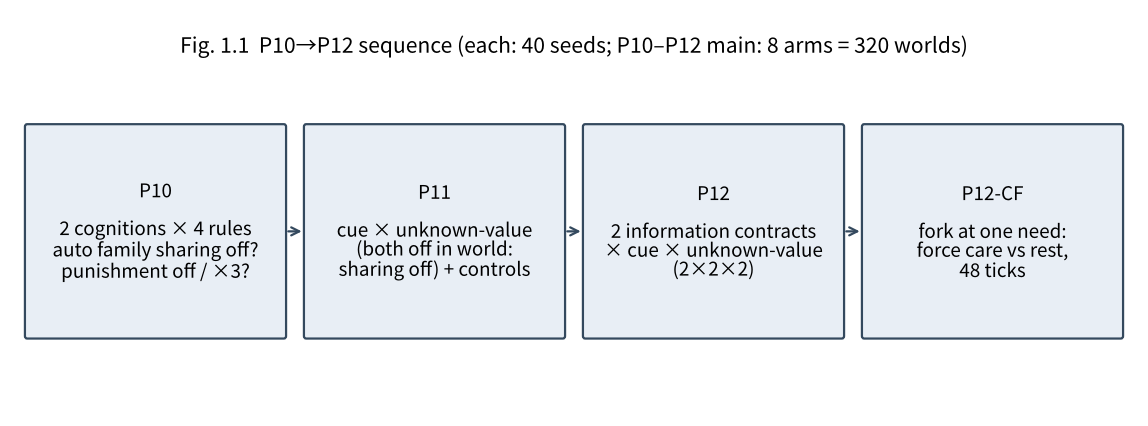
World. Each world uses the default research configuration: 12 initial residents, labour costs 1 energy, carry capacity 20, trade discovery on, 480 ticks (four model years). In P11 and P12 the automatic family food-sharing rule is switched off; explicit care remains available as a resident action.
P10 (2 × 4 = 8 arms). Controller {old (legacy fixed-utility table), unified (mind9)} × rule {base; noshare = automatic household transfer off; nopunish = automatic peer punishment off; strong = punishment strength ×3}. Seeds: development 9401–9402 (seen, excluded), pilot 1101–1110, confirmation 1201–1240.
P11 (8 arms). base; cue (a visible, weak dependant raises care in the resident's attention); unknown (untried actions get an aspiration value rather than zero); both (cue + unknown); old_noshare; bonus (a positive-control utility bonus on care); base_share and both_share (automatic sharing back on). Confirmation seeds 1501–1540.
P12 (2 × 2 × 2 = 8 arms). Information contract {inherited, legal} × cue {off, on} × unknown-value {zero, aspiration}. Under the legal contract, an adult's care candidates use only the energy that is visible for family children within sight, ordered by visible energy, distance and ID; hidden food and wood inventories of the child are not read when generating options. The executor, however, still consults the true inventory when the adult reaches the child to limit the transferred quantity (a limitation discussed below). Seeds: development 9601–9604, pilot 1651–1652, confirmation 1701–1740.
P12 care-versus-rest fork. Counterfactual seeds 1801–1840. From each snapshot, one adult at the next scheduled care opportunity was forced either to care or to rest; the controller then resumed in both branches, which were followed for 48 ticks. Seeds 1805 and 1821 had no eligible opportunity and are excluded, not replaced (38 eligible).
Why this design. Running every arm from the same seed lets differences be attributed to the arm. Removing an automatic rule is an ablation: it shows how much of an outcome the rule supplied. The legacy controller serves as a contrast: if its care rises when the rule is removed, the care was pre-programmed.
5. Variables and Operationalization
| Variable | Role | Operational definition | Unit |
|---|---|---|---|
| Controller | Independent (P10) | old (legacy utility) vs unified (mind9) | categorical |
| Automatic household sharing | Independent (P10); fixed off in P11/P12 | Engine moves food among co-located family members every tick | on/off |
| Automatic punishment; punishment strength | Independent (P10) | Peer punishment of thieves; impact ×1 or ×3 | on/off; multiplier |
| Care cue | Independent (P11, P12) | Dependants' visible weakness boosts the care candidate's priority | on/off |
| Unknown-value rule | Independent (P11, P12) | Value assigned to never-tried actions: zero or aspiration level | categorical |
| Information contract | Independent (P12) | inherited (candidate generation could read the child's hidden stores) vs legal (visible energy only) | categorical |
| Forced action | Independent (fork) | care vs rest at one opportunity | categorical |
| Child starvation | Dependent | Children dying from starvation (not the age/disease hazard) | deaths per 480-tick world |
| Care transfers (P10, P11); positive transfers (P12) | Dependent | Resident-chosen food transfers to a dependant (P12: quantity > 0) | transfers per world |
| Consideration rate (T2|T3), selection rate (T5|T3) | Dependent | Share of care candidates considered, or selected, by the controller | proportion |
| First effective carers | Dependent (P12-H2) | Independent residents whose first positive-quantity care attempt occurred | residents per world |
| Theft | Dependent (P10) | Theft events | events per world |
| Alive at 48 ticks; alive-ticks; transfer; fatigue | Dependent (fork) | Whether the reference child is alive at 48 ticks; ticks alive within 48; food actually transferred; adult fatigue difference | binary; ticks; food units; fatigue units |
| Fixed controls | Control | 12 residents, 480 ticks, labour cost 1, carry cap 20, same seed across arms | — |
6. Sample and Experimental Units
The unit of inference is the world (seed); paired differences are computed within each seed. P10, P11 and P12 each include 40 confirmation seeds × 8 arms = 320 worlds. Residents, decisions and ticks within a world are dependent and are never counted as independent observations. In the fork study the unit is the eligible seed (n = 38). No seed was removed after the fact. Development and pilot seeds were seen during design and are excluded from inference; the P10 pilot (80 worlds) found no technical defects and changed nothing. The pooled decision-stage counts in Tables 1.3–1.4 are descriptive.
7. Methods and Statistical Analysis
For every primary and secondary contrast, the per-seed difference between a treated arm and its control was computed. We report the mean paired difference, a 95% percentile bootstrap interval (10,000 resamples of seeds, fixed random generator), the counts of seeds in which the difference was positive, zero or negative, and an exact two-sided sign test on the non-zero differences (zeros dropped). Within each study the four primary p-values are Holm-adjusted. A hypothesis is supported only if the Holm-adjusted p < 0.05 and the interval lies wholly on the predicted side. Secondary contrasts are pre-specified but uncorrected and are interpreted as estimates, not discoveries. Fork-study intervals use a smaller bootstrap (5,000 resamples for some fork quantities in the frozen file; the frozen intervals are reported) and are descriptive.
How to read an interval and a sign test. The interval is the range of mean paired differences consistent with the 40 observed worlds under resampling; if it excludes zero, the mean difference is distinguishable from zero. The sign test asks only whether positive and negative seeds are split far from evenly. With 31 positive, 2 negative and 7 zero seeds, the split is far more lopsided than a fair coin would give. A mean can be large while the sign test is weak when a few worlds dominate (as for P10-H3).
8. Results
8.1 P10 – removing automatic sharing and punishment
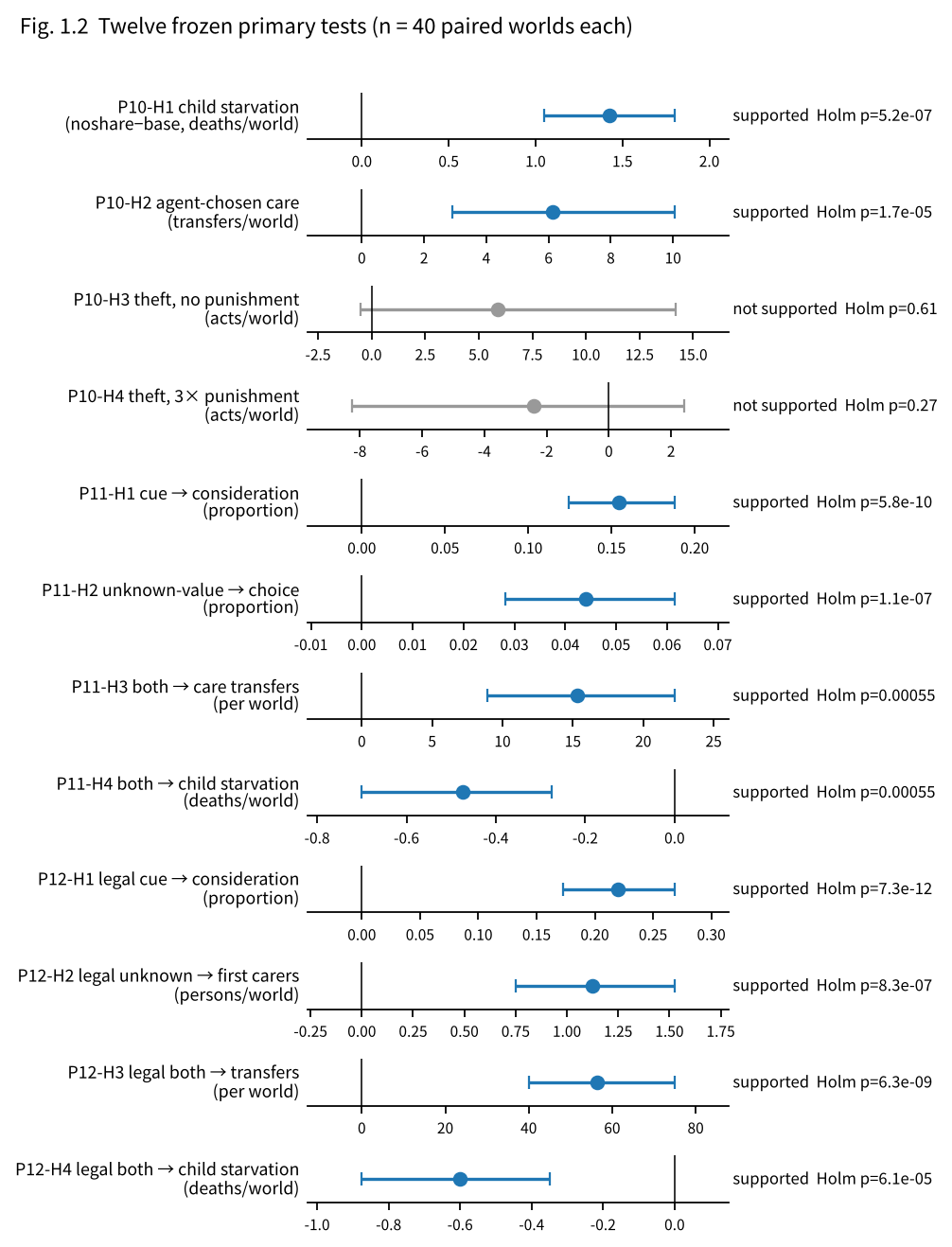
Table 1.1. P10 primary tests (mind9; n = 40 paired worlds each; two-sided exact sign test; Holm over four).
| ID | Contrast | Outcome (unit) | Mean difference | 95% CI | Seeds +/0/− | Holm p | Supported |
|---|---|---|---|---|---|---|---|
| H1 | noshare − base | Child starvation (deaths/world) | +1.425 | [1.050, 1.800] | 31/7/2 | 5.23×10⁻⁷ | Yes |
| H2 | noshare − base | Care transfers (per world) | +6.125 | [2.900, 10.050] | 22/17/1 | 1.72×10⁻⁵ | Yes |
| H3 | nopunish − base | Thefts (per world) | +5.875 | [−0.525, 14.200] | 19/6/15 | 0.608 | No |
| H4 | strong − base | Thefts (per world) | −2.425 | [−8.250, 2.425] | 10/11/19 | 0.272 | No |
Reading H1. We compared worlds in which the engine no longer shares food within families against identical worlds in which it does. The outcome counts children who died of starvation in 480 ticks. Without the rule, 1.425 additional children per world starved on average; the interval excludes zero; in 31 of 40 seed pairs starvation rose. This supports the hypothesis: in this model, child survival under mind9 depended substantially on the automatic rule. Reading H2. The same removal increased resident-chosen care by 6.125 transfers per world (22 seeds up, 1 down). Residents did start caring more; the increase was not enough to offset the loss (H1). Reading H3–H4. Removing or tripling punishment did not produce a detectable change in theft; mean differences are positive and negative respectively, but intervals include zero and the world-level signs are split. This is not evidence that sanctions are ineffective in general; it means this design could not detect an effect.
Contrast with the legacy controller (secondary, uncorrected). Under the legacy table, removing automatic sharing changed child starvation by 0.000 per world (95% CI −0.175 to 0.175) while care transfers rose by 41.925 per world. The care that compensated was written into the table as a fixed utility, so a reassuring outcome here reflects the designer's prior, not a discovered behaviour. This is the central reason P10 is informative: it separates "outcome present" from "resident decision present".
8.2 P11 – where does the care chain break?
We follow, for each care opportunity, a chain of stages: an objective opportunity (T0), the target in sight (T1), care generated as a candidate (T3), considered (T2), valued positive (T4), selected (T5), executed (T6). The counts have different denominators and are not a funnel whose percentages multiply. Examples are given in Table 1.3.
Table 1.2. P11 primary tests (mind9; n = 40 paired worlds; two-sided exact sign test; Holm over four).
| ID | Contrast | Outcome (unit) | Mean difference | 95% CI | Seeds +/0/− | Holm p | Supported |
|---|---|---|---|---|---|---|---|
| H1 | cue − base | Consideration rate (proportion) | +0.1544 | [0.1242, 0.1879] | 38/1/1 | 5.82×10⁻¹⁰ | Yes |
| H2 | unknown − base | Selection rate (proportion) | +0.0441 | [0.0283, 0.0615] | 36/1/3 | 1.08×10⁻⁷ | Yes |
| H3 | both − base | Care transfers (per world) | +15.325 | [8.925, 22.225] | 27/7/6 | 5.49×10⁻⁴ | Yes |
| H4 | both − base | Child starvation (deaths/world) | −0.475 | [−0.700, −0.275] | 1/23/16 | 5.49×10⁻⁴ | Yes |
Table 1.3. P11 pooled stage counts across 40 worlds (descriptive; different denominators; not independent observations).
| Arm | T0 opportunities | T1 in sight | T2 considered | T4 valued positive | T5 selected | T6 executed |
|---|---|---|---|---|---|---|
| base | 11,248 | 6,253 | 2,531 | 289 | 377 | 292 |
| cue | 11,664 | 6,478 | 4,315 | 401 | 483 | 385 |
| unknown | 12,024 | 6,680 | 3,344 | 950 | 977 | 710 |
| both | 13,472 | 7,597 | 4,866 | 1,219 | 1,184 | 905 |
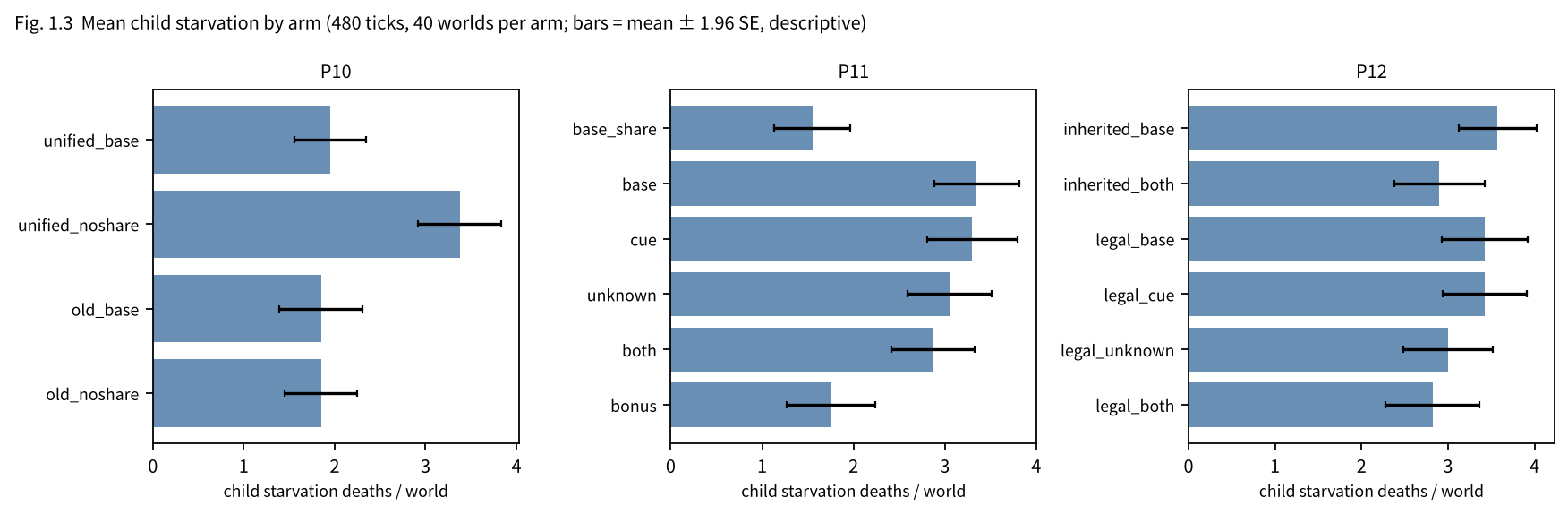
Reading. In the base arm only 2,531 of 11,248 care candidates were considered at all (counts pooled over worlds); the cue raises consideration (+0.154 on a proportion scale), the neutral value raises how often what is considered is selected (+0.044), and the two together raise executed care by 15.3 transfers per world and avert 0.475 child starvation deaths per world. The positive control (a utility bonus on care) and the arms with automatic sharing back on show what a stronger or older protection yields (Figure 1.3). The effect on starvation is smaller than the effect of the automatic rule (P10), so these simple changes recovered only part of the lost protection.
Superseded interpretations. The original P11 report interpreted the stages as a funnel, reported "legally autonomous" care estimates, and explained low repeat-care rates causally. These interpretations were withdrawn after P12 and P15 because (i) denominators differ, (ii) the inherited candidate generator read hidden information, and (iii) repeat rates cannot identify preference or learning failure. Only the numerical contrasts above are retained.
8.3 P12 – care under a legal-information contract
Table 1.4. P12 primary tests (legal contract; n = 40 paired worlds; two-sided exact sign test; Holm over four).
| ID | Contrast | Outcome (unit) | Mean difference | 95% CI | Seeds +/0/− | Holm p | Supported |
|---|---|---|---|---|---|---|---|
| H1 | legal_cue − legal_base | Consideration rate (proportion) | +0.2195 | [0.1730, 0.2685] | 40/0/0 | 7.28×10⁻¹² | Yes |
| H2 | legal_unknown − legal_base | First effective carers (residents/world) | +1.125 | [0.750, 1.525] | 26/13/1 | 8.34×10⁻⁷ | Yes |
| H3 | legal_both − legal_base | Positive care transfers (per world) | +56.400 | [40.000, 74.950] | 34/5/1 | 6.29×10⁻⁹ | Yes |
| H4 | legal_both − legal_base | Child starvation (deaths/world) | −0.600 | [−0.875, −0.350] | 0/25/15 | 6.10×10⁻⁵ | Yes |
Secondary contrast, contract effect. legal_both − inherited_both: child starvation −0.075 per world (95% CI −0.400 to 0.250; uncorrected) and positive transfers +62.050 per world (95% CI 42.500 to 83.375; uncorrected). In words: moving to the legal contract changed how often care was recorded but did not establish additional survival. A later diagnosis found that the executor clipped transfer quantities using hidden inventory; a recorded transfer is therefore not equivalent to effective help, and the legal contract applies only to the care pathway.
8.4 Care versus rest (counterfactual fork)
Table 1.5. Care-versus-rest forks (38 eligible seeds; descriptive, uncorrected 95% intervals from the frozen analysis).
| Quantity | Care | Rest | Difference (care − rest) | 95% CI |
|---|---|---|---|---|
| Reference child alive at 48 ticks (count of 38) | 28 | 17 | +0.2895 (proportion) | [0.1316, 0.4474] |
| Alive-ticks within 48 | — | — | +8.184 ticks | [4.026, 12.816] |
| Fatigue of the adult | — | — | +12.593 units | [12.082, 12.967] |
Mean food actually transferred was 3.086 units per opportunity (30 positive, 8 zero). The forced-care branch had higher survival in most pairs, but the figure also contains cases where the care branch did worse (Figure 1.4).
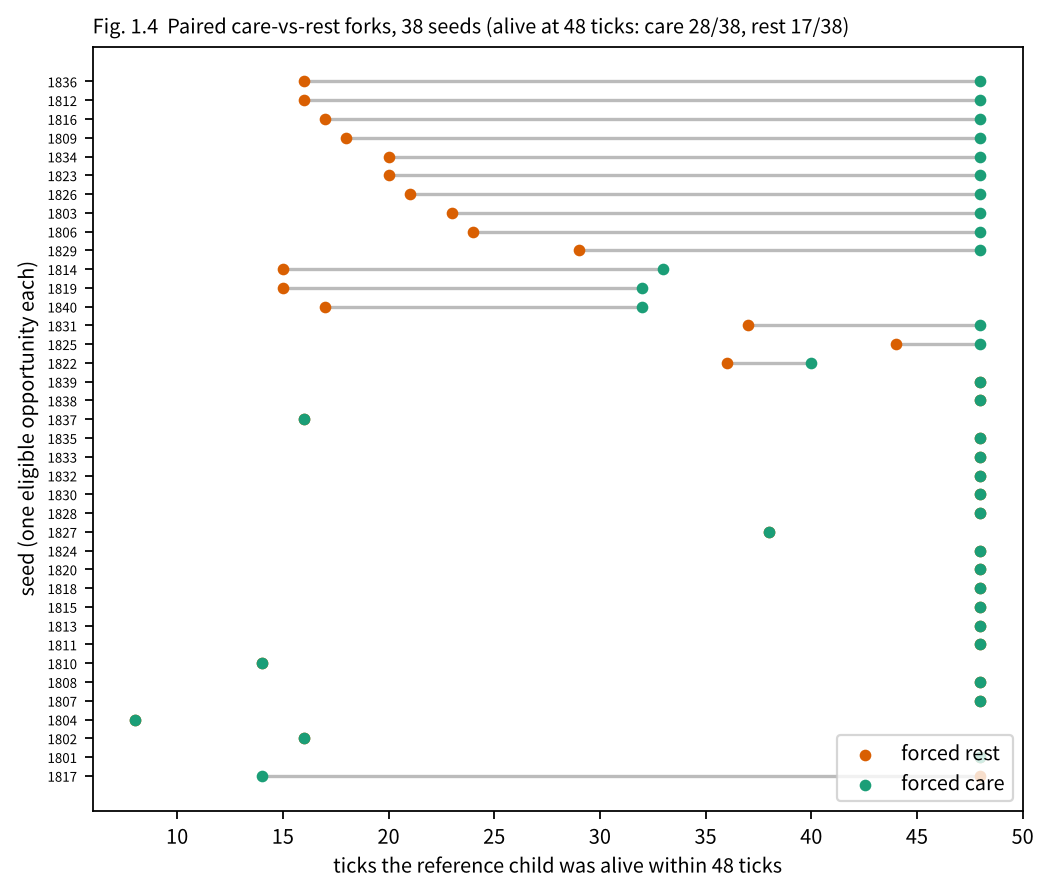
Reading. The comparison isolates the effect of forcing one particular next action, including how the adult and child behave afterward (a total effect). It does not isolate food units, it was forced by the researcher, and in 36 of 38 pairs the adult already held at least 12 food, in only 3 during winter, so the sample is skewed toward easy cases. Intervals are descriptive. The alive-ticks and fatigue intervals were computed with a different bootstrap size than the intervals recomputed independently for this edition; the frozen values are reported.
9. Discussion
What the data say. The central message is an attribution result. Under the learning controller, children's survival in the default world rests largely on a rule that nobody in the model chooses. When the rule is removed, residents do respond (more care transfers), but not enough. Under the legacy controller, the same removal leaves survival intact, because the table says to care. Observationally the two look alike; mechanistically they differ.
Why a cue and a neutral value help. A decision process cannot value an action it never considers, and mind9 gives untried actions a value of zero by default. Drawing attention to a dependant (cue) and treating untried actions as potentially worthwhile (unknown value) increase, respectively, how often care is considered and how often it is selected. In the model this is a statement about decision machinery; it is not evidence of compassion or moral learning.
Why information boundaries matter. Candidate generation in the inherited code used hidden stores; restricting it to visible energy changed care counts substantially, but a comparison against the inherited contract did not reveal extra survival. Two interpretations remain open and cannot be separated by these data: that the inherited contract already supplied adequate targeting, or that executor-side clipping and other residual shortcuts absorb the benefit.
What the fork adds. The forced-care result indicates that, in this model, one act of care can matter for a child's next 48 ticks, which is consistent with care being worth choosing, but the adult's controller has no mechanism in this design for learning that from the child's later survival.
Relation to prior work. Agent-based studies of cooperation typically explore mechanisms such as reciprocity or reputation [1,3]; here the contribution is a methodological one, namely separating a rule that supplies helping from a decision that produces it. The results neither confirm nor contradict inclusive-fitness theory [2], which concerns evolved dispositions rather than the within-lifetime choices of a short-lived simulation.
10. Limitations
- Model, not humans. No inference to real families or policy. The residents' energy economy and the care rules are simplifications.
- Narrow information repair. The legal contract covers the care pathway only; other behaviours still use inherited shortcuts, and energy visibility is a modelling assumption. Executor-side clipping by hidden inventory was found after the fact.
- Effects are totals. Each contrast bundles direct effects with behavioural adaptation downstream; mechanisms are not isolated.
- Short horizon. 480 ticks (four model years); children do not reach maturity (1,680 ticks).
- Two primary hypotheses unresolved. Theft results are non-significant with wide intervals; absence of detected effect is not evidence of no effect.
- Fork study. 38 seeds; forced action; adults mostly well fed; descriptive intervals; at least one case where care did worse; different bootstrap size across analyses.
- Superseded interpretations. P11's original funnel and repeat-care explanations are withdrawn.
- Governance of evidence. Preregistration was internal (local version control), no public registry; no independent replication; the analysis scripts reference modules that are not distributed; protocols were drafted with an AI coding assistant under the owner's direction (wording to be confirmed by the owner).
11. Conclusion
In this artificial society, switching off the automatic rule that shares household food raises child starvation by 1.425 deaths per world under the learning controller (Figure 1.3 shows roughly 2 rising to roughly 3.4), and residents' own care compensates only in part. A simple attention cue plus a neutral value for untried actions increases care and lowers starvation, and these gains persist when the care pathway is limited to legitimately visible information; however, the added care did not demonstrably improve survival relative to the earlier information contract. A single forced act of care raised the chosen child's short-term survival. The studies show how far apparent social outcomes can be a property of the engine, and how to test for it. They do not show that compassion, norms or kin care emerge, and they say nothing about humans.
12. Data Availability and Reproducibility
The evidence package SC-P10-P12-Autonomous-Care contains frozen protocols and reports, per-world result files for the three confirmation sets, frozen analysis outputs, funnel and counterfactual CSV files, analysis scripts and release metadata (CC BY 4.0 for data and documents; MIT for scripts). The download link, SHA-256 checksum, licences and citation are given in the dataset panel below. For this edition, all primary and secondary statistics quoted above were recomputed from the per-world rows with an independent script (sign tests, bootstrap intervals and Holm adjustment reproduced the frozen values; the alive-ticks and fatigue intervals of the fork study differ slightly because of a different bootstrap size, so frozen values are quoted). The simulation engine, dependency lock files, per-tick event streams and raw git history are not distributed, so the simulations cannot be re-run from the package; the package's analysis scripts import non-distributed modules. File and path names inside the package still use the project's earlier name "Emergentia". Release status: version 1.0.0 published for public download on 2026-11-12.
SHING CIVITAS P10-P12 Autonomous Care Dataset
SHING CIVITAS P10–P12 自主照护研究数据集
Three consecutive simulated-society experiments (P10, P11, P12) on autonomous care: the effect of disabling scripted household food sharing; locating the care breakdown with need cues and value visibility; and replication under a lawful care-information contract, with a paired one-care-versus-one-rest counterfactual. Frozen protocols, verified aggregate statistics, per-world result rows, analysis scripts and chart data.
- Version
- v1.0.0
- Creator
- Martin Zhong
- Publisher
- SHING CIVITAS
- Released
- November 12, 2026
b9c86aa38d893ebb41f8b9690a2c21918ffb78845f6660c3da41a754869d5747Verify after download: sha256sum SC-P10-P12-Autonomous-Care-v1.0.zip · PowerShell Get-FileHash SC-P10-P12-Autonomous-Care-v1.0.zip
Data, figures and documentation: CC BY 4.0. analysis/ scripts: MIT. The simulation engine is not included. Full licence texts are in LICENSES/; the per-file map is metadata/LICENSE_MAP.md.
Zhong, M. (2026). SHING CIVITAS P10-P12 Autonomous Care Dataset (Version 1.0.0) [Data set]. SHING CIVITAS. https://shingcivitas.com/
BibTeX
@dataset{zhong2026_p10p12autonomouscare,
  author    = {Zhong, Martin},
  title     = {SHING CIVITAS P10-P12 Autonomous Care Dataset},
  year      = {2026},
  version   = {1.0.0},
  publisher = {SHING CIVITAS},
  url       = {https://shingcivitas.com/}
}
Entry type @dataset requires biblatex; classic BibTeX reports it as unknown. Machine-readable citation metadata: CITATION.cff (CFF 1.2.0) inside the ZIP. No DOI has been assigned.
- Recalculating results from the data
- supported — aggregate statistics can be recomputed from data/ with any CSV/JSON tool or the statistical functions in analysis/
- Reproducing the published statistical analysis
- partial — analysis/*.py document the frozen statistical rules but import private modules (civlab, scripts, p12_study) that are NOT distributed, so the pipeline cannot run end to end
- Re-running the simulations
- not supported — engine source, dependency lock, per-tick event streams, model version snapshot and API credentials are absent by design
Inside: README.md (overview), CITATION.cff, LICENSE and LICENSES/, metadata/LICENSE_MAP.md, metadata/CHECKSUMS.sha256. File names inside still use the project’s earlier name “Emergentia”.
References
Publication records, publisher pages and DOI metadata were checked on 2026-11-12. These external works support the theoretical or methodological background, not any SHING CIVITAS result.
- 1Axelrod, R. (1984). The Evolution of Cooperation. Basic Books. https://search.worldcat.org/title/The-evolution-of-cooperation/oclc/10274775
- 2Hamilton, W. D. (1964). The genetical evolution of social behaviour. I & II. Journal of Theoretical Biology, 7(1), 1–16 and 17–52. https://doi.org/10.1016/0022-5193(64)90038-4 ; https://doi.org/10.1016/0022-5193(64)90039-6
- 3Nowak, M. A., & Sigmund, K. (1998). Evolution of indirect reciprocity by image scoring. Nature, 393, 573–577. https://doi.org/10.1038/31225
- 4Simon, H. A. (1955). A behavioral model of rational choice. The Quarterly Journal of Economics, 69(1), 99–118. https://doi.org/10.2307/1884852
- 5Holm, S. (1979). A simple sequentially rejective multiple test procedure. Scandinavian Journal of Statistics, 6(2), 65–70. https://www.jstor.org/stable/4615733
- 6Efron, B. (1979). Bootstrap methods: Another look at the jackknife. The Annals of Statistics, 7(1), 1–26. https://doi.org/10.1214/aos/1176344552
Verification register: See Appendix C · Reference register for source links, bibliographic corrections and scope.