Article 2·P17–P18·v3.0
A Tool Can Be Useful Without Being Worth Making: Scarcity, Opportunity Cost and Economic Decisions in an Artificial Society
Under scarcity a free tool and a food reserve had large positive value and a free house did not; making a tool from scratch was not shown to pay for the learning controller mind9.
SHING CIVITAS Research Series · Article 2 · Studies P17, P18 (with P16-A/B background) · Version 3.0, bibliography and model-identity revision, 2026-11-12 · Status: published on the SHING CIVITAS website, 2026-11-12; not externally peer reviewed
Terms such as tick, world, seed, fork and controller are explained in the introductory article.
1. Title and Abstract
Abstract
When a simulated society builds few tools, houses or exchanges, one may suspect that its residents lack foresight. That inference is unsafe if the world is so generous that the actions have little objective value.
P17 first asked under what physical conditions an action has measurable value. Five worlds (an unconstrained control C; a crowded world F1_pop192; a food-capacity-2 world F2a_cap2; and two capacity-2 worlds with rain shocks, unsynchronized F3u_cap2 and synchronized F3s_cap2) were crossed with two controllers (the legacy utility table "old" and the learning controller mind9). In 40 paired seeds (18201–18240), identical snapshots at tick 60 were forked and run to tick 300, with researcher interventions: free tool (T), free house (H), food top-up to carry limit (R), mutual-aid removal and exchange removal. The outcome was alive person-ticks over 240 ticks. P18 then separated four causal questions about tools in C and F2a_cap2 using forks A (unchanged), T, K (forced chop-then-craft with all costs paid), KV (as K, tool then removed), P (craft whenever legal) and P1 (craft once), 40 seeds (19201–19240). The inferential unit is the world; one-sided exact sign tests, seed-paired bootstrap 95% intervals and Holm correction were used, with "supported" requiring both Holm p < 0.05 and a lower interval bound above zero.
In P17, all four constraint-index tests (share of healthy-adult person-ticks with energy below 45) were supported (+0.023 to +0.073). A free tool raised alive person-ticks in all four constrained worlds (e.g. +144.425, 95% CI 89.675 to 199.575, Holm p = 3.3×10⁻⁶ in F2a_cap2); a food top-up raised them by +465 to +3,135 (4 of 4 supported); a free house was supported in 0 of 4. In P18 (capacity 2), for mind9, making a tool from scratch was not shown to pay (K − A = +29.475, 95% CI −18.375 to 77.825, Holm p = 0.337), nor was a "craft whenever legal" habit (P − A = +57.325, bootstrap 95% CI 8.975 to 104.0 but sign test not significant; Holm p = 0.182); for the legacy controller K − A was supported (+59.175, Holm p = 0.0044), but its crafting preference was programmed. The planned learning experiment (Stage D) did not pass its gate and was not run.
In this model a tool is valuable under scarcity once it is in hand (use value about +201 person-ticks) but not clearly worth manufacturing from scratch for a controller that learns from immediate bodily changes. These are simulation results and do not describe real economies.
Keywordsartificial societyscarcityopportunity costtool useinvestmentcounterfactual forksbounded rationality
2. Research Background
Economists describe investment as accepting a cost now for a return later, and Böhm-Bawerk's account of "roundabout" production has the same structure: time and materials are spent on a tool because it raises later output [1]. Whether a decision-maker undertakes such investment depends on the scarcity it faces, the cost of the tool, and its capacity to attribute a delayed benefit to an earlier action. Bounded-rationality accounts predict that agents who evaluate few options with immediate feedback will under-invest in delayed returns [2], and reinforcement-learning treatments of credit assignment give the same difficulty a formal name: a reward that arrives many steps after the causal action must be attributed across time [3].
In an artificial society, however, a failure to build tools has at least two possible origins. The world may not make a tool worth building, or the controller may fail to value a tool that is worth building. Studies P16-A and P16-B (summarized only as background here; their packages are partial) had found that tools and houses were not clearly valuable in the default world. P17 therefore changed the world first, asking where objective value appears. P18 then held the world fixed and decomposed "the value of a tool" into four estimands that are easy to confuse (Section 4).
3. Research Questions and Hypotheses
(Q1) Which physical conditions (crowding, low food capacity, rain shocks) leave healthy adults actually constrained? (Q2) Under those conditions, do a tool, a house, a food reserve, mutual aid or exchange have objective value? (Q3) What does it cost, and what does it return, to make a tool? (Q4) Would a controller that learns from immediate bodily feedback choose to make one?
Table 2.1. Frozen primary hypotheses. One-sided exact sign tests; Holm correction within each family; supported = Holm p < 0.05 and 95% CI lower bound above zero.
| Family | Hypothesis | Prediction |
|---|---|---|
| P17 H1 (4 tests) | A constrained world W (F1_pop192, F2a_cap2, F3u_cap2, F3s_cap2) has a higher constraint index than C | CIE(W) − CIE(C) > 0 |
| P17 H2 (12 tests) | In each constrained world W, a tool (T; mind9 background only), a house (H; both controllers pooled) and a food top-up (R; pooled) each raise alive person-ticks | Vk(W) = fork k − fork A > 0, k ∈ {T, H, R} |
| P18 (4 tests) | In F2a_cap2, for each controller, (i) paid manufacture from scratch and (ii) craft-whenever-legal raise alive person-ticks | K − A > 0; P − A > 0 |
Pre-specified secondary analyses (uncorrected) included mutual-aid and exchange removal, the control world C as a negative control, the use value K − KV and full cost KV − A of a tool, single-craft P1, material outcomes and time-to-payback.
4. Research Design
Worlds. All worlds use the default research world with 12 initial residents except where stated. C: food capacity 10 per tile (negative control). F1_pop192: initial population 192 on the same map (density and group size change together; this is not a pure world parameter). F2a_cap2: food capacity 2 (all else equal). F3u_cap2 / F3s_cap2: capacity 2 with rain shocks of standard deviation 1.0 that are uncorrelated (u) or synchronized (s) across regions. Dose selection used development seeds 18001–18004 and pilot seeds 18101–18102; seed 18001 had been seen in a smoke test before the protocol was written (disclosed in the protocol; it remained a development seed).
P17 forks (two controllers × five worlds). Each confirmation world was run for 60 ticks (warm-up), snapshotted, and forked to tick 300: A (unchanged); T (every adult without a tool receives one); H (the household selected by the P16-A rule receives a finished house); R (adults' food is topped up to the carry limit, a measure of storage potential, not of residents' ability to save); M (mutual aid switched off); X (exchange opportunities removed). Each fork's behaviour was checked against an uninstrumented twin world with the same intervention by per-tick state hash.
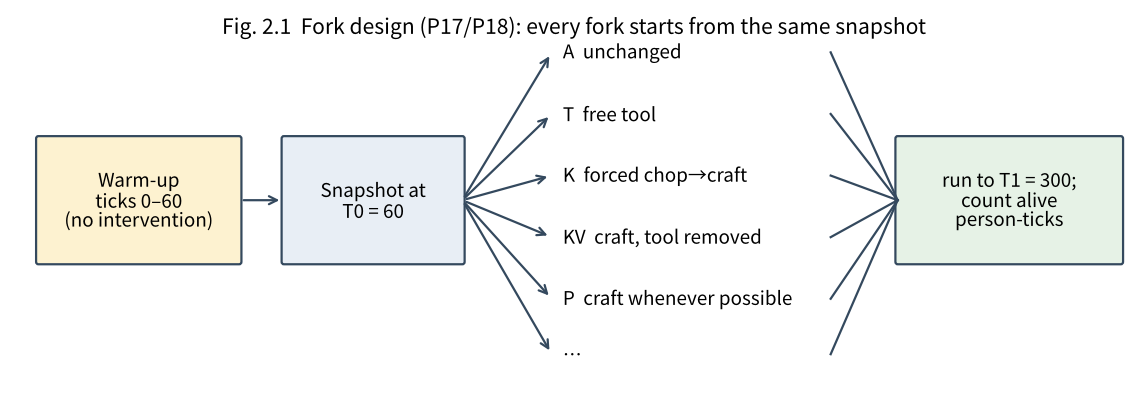
P18 forks (capacity 2 and C; mind9 and old). A; T (free tool); K (adults without a tool are driven by the researcher to chop until they hold at least 3 wood and then craft once, paying wood, actions, fatigue and labour energy, then resume their own controller); KV (as K, but the tool is taken away immediately after crafting); P (any adult executes craft whenever it is a legal candidate: no tool, wood ≥ 3, fatigue < 95); P1 (an adult without a tool crafts once, at its first legal opportunity). Forced actions replace the executed action after the resident's own decision (random draws are still consumed). No forced craft is an autonomous craft.
The four estimands.
| Contrast | Question | Key limitation |
|---|---|---|
| T − A | What is a free tool worth? | Acquisition is free |
| K − A | What does paid manufacture from scratch return net of every cost? | Researcher-driven; a pessimistic cost path |
| K − KV | What is a tool worth once its cost is sunk? | Use value only |
| KV − A | What does one manufacture cost (without using the tool)? | Cost only |
| P − A | What is a "craft whenever carrying enough wood" habit worth? | A programmed habit, not a learned one |
| R − A | What is stored food worth? | Researcher top-up; not residents' ability to save |
Gate. If mind9's P − A were supported, a diagnostic Stage C would target "craft when crafting is a candidate"; if only K − A were supported, Stage C would still proceed; if neither, the project would stop cognitive changes and issue only a diagnostic report (Stage D, a learning experiment, would not be run).
5. Variables and Operationalization
| Variable | Role | Operational definition | Unit |
|---|---|---|---|
| World (C, F1_pop192, F2a_cap2, F3u_cap2, F3s_cap2) | Independent | Population, food capacity, rain shock correlation | categorical |
| Controller (old, mind9) | Independent | Legacy table vs learning controller (with the legal care contract from Article 1) | categorical |
| Fork (A, T, H, R, M, X; K, KV, P, P1) | Independent | Researcher intervention applied at tick 60 | categorical |
| Constraint index CIE | Dependent (H1) | Share of healthy-adult person-ticks with energy < 45 (measurement window ticks 60–480 in dose selection) | proportion |
| Alive person-ticks | Dependent (H2, P18) | Sum over residents present at tick 60 of ticks alive until tick 300 | person-ticks per world (240-tick window) |
| Value Vk | Derived | Fork k − fork A, same seed | person-ticks |
| Focal-adult material outcomes | Secondary | Food gathered, wood, crafts, tool-holding ticks | units; ticks |
| Controls | Fixed | 12 initial residents (except F1), same seed, same snapshot, same hash checks | — |
6. Sample and Experimental Units
P17: 40 confirmation seeds (18201–18240) × 5 worlds × 2 controllers × forks (A, T, H, R, M, X) per world; the unit is the paired world (n = 40 per test). P18: 40 confirmation seeds (19201–19240) × 2 worlds (C, F2a_cap2) × 2 controllers × forks (A, T, K, KV, P, P1). Development seeds were seen and excluded: P17 18001–18004 (18001 used in a smoke test before the protocol), pilot 18101–18102; P18 Stage A 19001–19008 and a development fork study on the same seeds, whose results (for mind9, K − A about +84 and P − A about +124 in capacity 2) led the authors to list both contrasts as primary; Stage C diagnostics 19001–19016. Residents, actions and ticks are not independent units. Six seeds with zero difference are dropped from the sign test of mind9 P − A (22 positive, 12 negative).
7. Methods and Statistical Analysis
For each seed the paired difference Vk = (alive person-ticks in fork k) − (in A) was computed. We report its mean, a 95% percentile bootstrap interval (10,000 resamples of seeds), counts of seeds with positive and negative difference, and the one-sided exact sign test (zeros dropped) for the frozen primary families; Holm adjustment was applied within each family (P17: 16 tests; P18: 4 tests). "Supported" = Holm p < 0.05 and interval lower bound > 0. When a primary test's bootstrap interval excludes zero but the sign test is not significant, the preregistered rule is to report "not supported" (this occurs for mind9 P − A). Secondary contrasts are reported with their uncorrected intervals. Note that one-sided tests test only the predicted direction: for P17-H, a significantly negative value would not be flagged by the test, and the figure marks such intervals explicitly.
8. Results
8.1 Which worlds constrain adults? (P17-H1)
Table 2.2. P17 H1: constraint index relative to C (n = 40 paired worlds).
| World | Mean difference in CIE (proportion) | 95% CI | Seeds + / − | Holm p | Supported |
|---|---|---|---|---|---|
| F1_pop192 | +0.0226 | [0.0188, 0.0264] | 40/0 | 1.46×10⁻¹¹ | Yes |
| F2a_cap2 | +0.0582 | [0.0460, 0.0713] | 39/0 | 1.64×10⁻¹¹ | Yes |
| F3s_cap2 | +0.0727 | [0.0592, 0.0868] | 40/0 | 1.46×10⁻¹¹ | Yes |
| F3u_cap2 | +0.0722 | [0.0575, 0.0884] | 40/0 | 1.46×10⁻¹¹ | Yes |
Reading. The index is the proportion of healthy-adult person-ticks with energy below 45. Even in the harshest world, only about 7 percentage points more adult person-ticks were constrained than in C, so adults are mildly, not severely, constrained; children and ill residents were constrained far more (in the dose-selection smoke test, 52–94% of child person-ticks below 45 versus under 1% of healthy adults at capacity 2). Constraint is defined by an energy threshold the authors chose.
8.2 What is a tool, a house or a reserve worth? (P17-H2)
Table 2.3. P17 H2: value of fork versus unchanged world (alive person-ticks over 240 ticks; n = 40 paired worlds per test).
| World | Fork | Mean difference | 95% CI | Seeds + / − | Holm p | Supported |
|---|---|---|---|---|---|---|
| F1_pop192 | Free tool (T) | +387.650 | [177.125, 593.850] | 28/12 | 0.0415 | Yes |
| F1_pop192 | Free house (H) | −161.963 | [−306.150, −18.000] | 13/27 | 1 | No |
| F1_pop192 | Food top-up (R) | +3,134.838 | [2,804.113, 3,463.163] | 40/0 | 1.46×10⁻¹¹ | Yes |
| F2a_cap2 | Free tool (T) | +144.425 | [89.675, 199.575] | 33/4 | 3.25×10⁻⁶ | Yes |
| F2a_cap2 | Free house (H) | +4.450 | [−10.300, 19.963] | 22/17 | 1 | No |
| F2a_cap2 | Food top-up (R) | +464.788 | [402.688, 529.075] | 40/0 | 1.46×10⁻¹¹ | Yes |
| F3s_cap2 | Free tool (T) | +215.950 | [164.100, 269.575] | 36/3 | 1.26×10⁻⁷ | Yes |
| F3s_cap2 | Free house (H) | +2.788 | [−14.713, 19.838] | 20/19 | 1 | No |
| F3s_cap2 | Food top-up (R) | +499.075 | [437.625, 561.475] | 40/0 | 1.46×10⁻¹¹ | Yes |
| F3u_cap2 | Free tool (T) | +234.650 | [180.350, 290.625] | 35/2 | 4.10×10⁻⁸ | Yes |
| F3u_cap2 | Free house (H) | −6.650 | [−23.513, 9.850] | 17/22 | 1 | No |
| F3u_cap2 | Food top-up (R) | +496.413 | [438.013, 554.800] | 40/0 | 1.46×10⁻¹¹ | Yes |
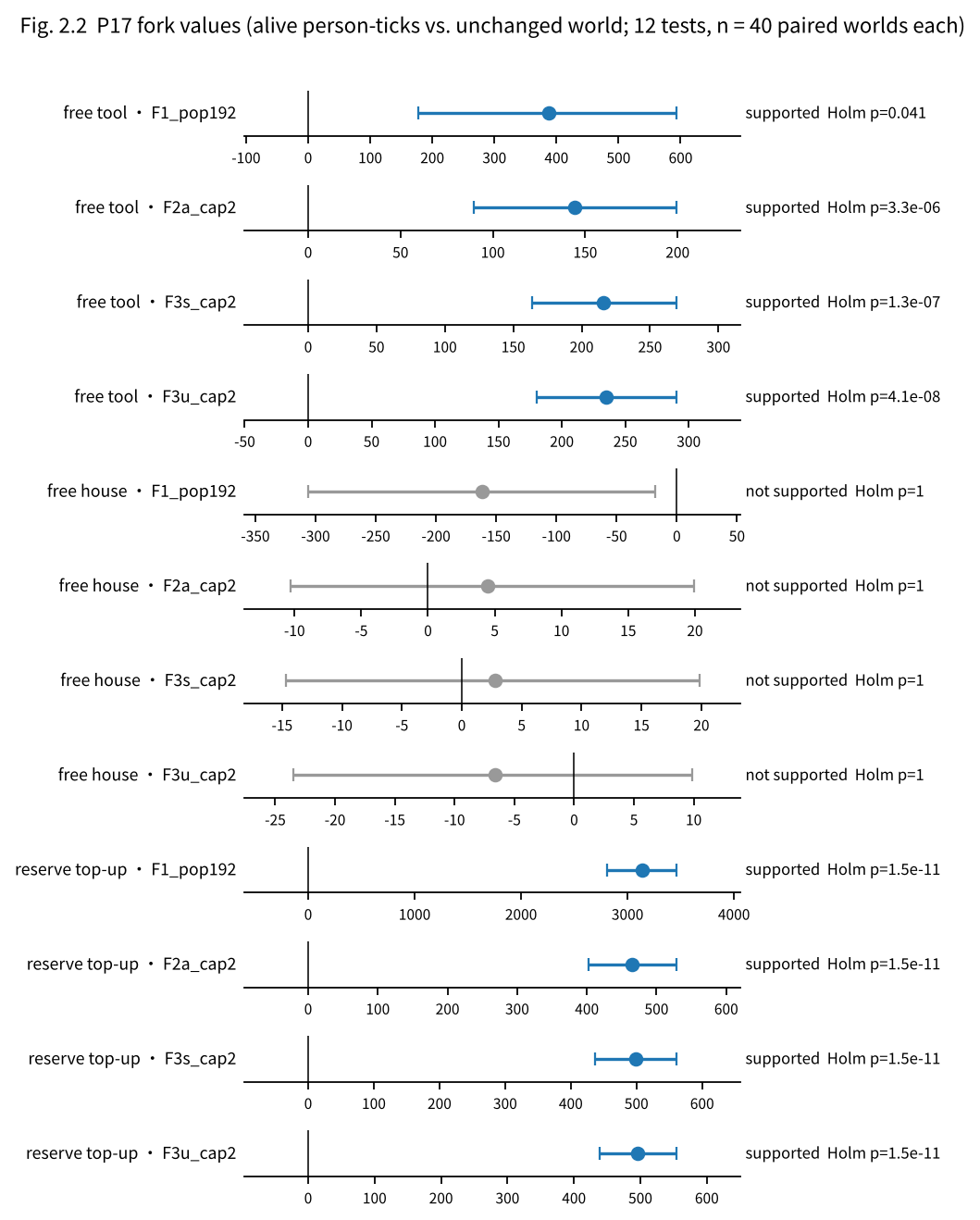
Reading. In every constrained world a tool is worth about 144 to 388 more alive person-ticks than not having one; because a total of about 12 residents × 240 ticks = 2,880 person-ticks are at stake in a 12-resident world, 144 is roughly 5% of the window (in the 192-resident world the base is much larger, so the proportion is smaller). The food top-up is worth far more (465 to 3,135) but measures only storage potential: the researcher supplied the food. A free house never met the criterion; in F1_pop192 its mean was negative with an interval below zero, which the one-sided test cannot flag as harm (Holm p = 1). The results for mutual-aid removal and exchange removal were secondary; the package's frozen outputs report no robust positive value for either, but those two comparisons were not independently recomputed for this edition and are therefore labelled provisional here.
8.3 What does making a tool return? (P18, capacity 2)
Table 2.4. P18 primary tests in F2a_cap2 (alive person-ticks over 240 ticks; n = 40 paired worlds; one-sided exact sign test; Holm over four).
| Controller | Contrast | Mean difference | 95% CI | Seeds + / − (zeros dropped) | Holm p | Supported |
|---|---|---|---|---|---|---|
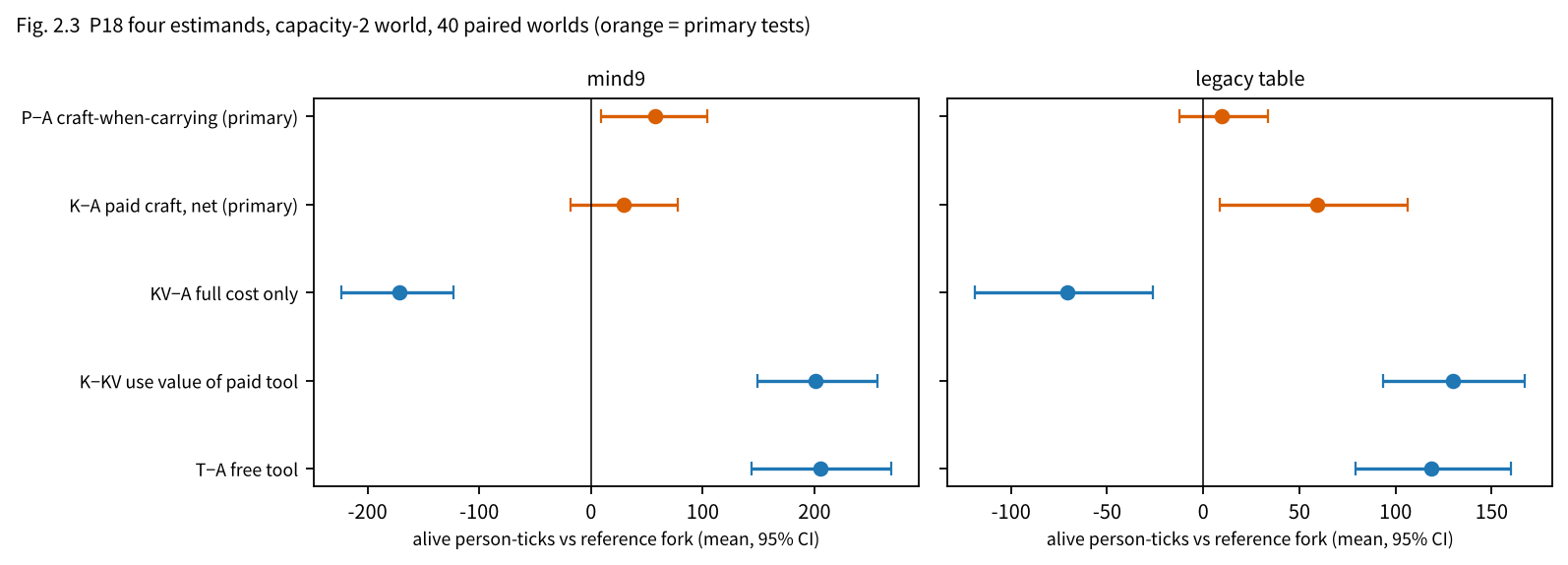
| mind9 | K − A (paid manufacture from scratch) | +29.475 | [−18.375, 77.825] | 23/16 | 0.337 | No |
| mind9 | P − A (craft whenever legal) | +57.325 | [8.975, 104.000] | 22/12 | 0.182 | No |
| old | K − A | +59.175 | [8.600, 106.425] | 30/10 | 0.0044 | Yes |
| old | P − A | +9.700 | [−12.125, 33.725] | 14/17 | 0.763 | No |
Secondary decomposition for mind9, F2a_cap2 (uncorrected). T − A ≈ +206; K − KV ≈ +201 (use value of an already-paid tool); KV − A ≈ −172 (the full cost of one manufacture, including wood and labour). Hence the use value roughly offsets the cost, leaving K − A near +29. Material outcomes for P − A: focal adults gathered +55.4 more food units (95% CI 37.9 to 73.2; 34 seeds up, 4 down) although survival did not clearly rise.
Reading. The bootstrap interval for mind9 P − A excludes zero, but 22 positive versus 12 negative seeds (6 ties) is too weak a split after correction; the frozen rule therefore reports it as not supported. Choosing the interval alone would reverse the preregistered decision. For the legacy controller, paid manufacture clearly pays, but that controller has a fixed preference to craft that is written into its table. Neither result shows that residents learned to invest.
8.4 Why does mind9 not value making the tool? (exploratory)
Stage C diagnostics (development seeds 19001–19016; exploratory, not confirmatory) examined mind9's valuation. Over 108 evaluated states the highest estimated value of craft never became positive (maximum −0.0095), and 72–90% of tool-less decisions occurred when the resident did not hold the 3 wood needed. These are consistent with an explanation in which the controller prices actions by same-tick own-body changes: crafting costs wood and time immediately, tool ownership is not in its value variables, and later extra foraging is credited to foraging. They are mechanistic clues from code inspection and development runs, not a confirmed causal result from the 40-world experiment, and they do not establish that "no long-term memory" is the single cause. The preregistered gate was not passed (mind9 P − A and K − A both not supported), so Stage D, a designed learning experiment, was not run; its design document describes an unimplemented plan.
9. Discussion
The main finding is a separation between value and decision. Under scarcity a tool has a clear measurable value (T − A, K − KV), but the value of acquiring it by one's own labour is close to zero for mind9 and cannot be told apart from zero in 40 worlds. The legacy controller shows that a controller that is told to craft would be better off in this world; mind9 is not told, cannot see the benefit, and does not do it. The conclusion is therefore about the match between a world and a decision process, not about "intelligence."
The negative house result is instructive: it shows that not every plausible asset has value merely because it exists; a free house did not meet the criterion in any constrained world. The strongly positive reserve result must not be read as evidence that residents would save; it quantifies the potential of storage when the researcher provides food.
Relation to literature: the structure of the P18 decomposition mirrors the credit-assignment problem [3] and the satisficing prediction [2], and the observation that delayed investment needs a world where it pays echoes standard accounts of capital accumulation [1]. These are analogies; the experiments do not test any economic theory.
10. Limitations
- Simulation only; no external validity to real economies, tools or households.
- Forced actions. T, K, KV, P, P1, R and H are researcher interventions; they show consequences, not autonomous adoption.
- Total, not isolated, effects. Forks include later adaptation of all residents.
- Short window. 240 ticks (two winters) cannot show intergenerational or long-run payoffs; adults are only mildly constrained.
- F1_pop192 confounds density with group size and differs in other ways.
- Seen development data shaped the choice of primary contrasts in P18 (disclosed); P17 seed 18001 was seen before the protocol.
- Sign test versus interval disagreement in mind9 P − A: reported as not supported by the frozen rule; a different pre-specification could have given a different label.
- One-sided tests cannot flag harm; negative intervals (F1_pop192 house) are interpreted only descriptively.
- Provisional secondary results: mutual-aid and exchange removal were not recomputed.
- Correction carried with citations of P16-B: the claim that zero-yield gathering at full inventory wore out tools had zero actual effect (the patch never fired); tool exhaustion arises from one durability unit consumed per gathering action regardless of yield.
- Governance: internal preregistration (local version control), no external replication, analysis scripts import undistributed modules, protocols drafted with an AI coding assistant under the owner's direction (wording to be confirmed).
11. Conclusion
In this model, scarcity makes tools and food reserves valuable and houses not, but a tool being valuable does not make it worth manufacturing for a controller that learns only from immediate bodily feedback. Paid manufacture net of cost was not shown to raise survival for mind9 (+29.5 person-ticks, interval spanning zero), and a craft-when-legal habit gave an equivocal result that fails the preregistered decision rule. The legacy controller benefits because a preference was written into it. The study supports a methodological point: judging residents' foresight requires first showing that the world rewards it, and then separating the value of having an object from the value of acquiring it.
12. Data Availability and Reproducibility
The evidence package SC-P17-P18-Tool-Economics contains protocols, reports, a mandatory CORRECTIONS file, per-world result files for the confirmation sets (including P16-A/B), frozen analysis JSON, primary-result CSVs and chart data, and scripts (CC BY 4.0 data and documents, MIT scripts). In this edition the P17 and P18 primary statistics (including every number in Tables 2.2–2.4) were recomputed from per-world rows; the frozen primary families use one-sided exact sign tests and Holm ranking, which reproduced the frozen Holm values exactly. The simulation engine, dependency lock files, per-tick streams and git history are not distributed, so the simulations themselves cannot be re-run; analysis scripts import undistributed modules. Names inside the package still use the earlier name "Emergentia". Release status: version 1.0.0 published for public download on 2026-11-12 (see the dataset panel below).
SHING CIVITAS P17-P18 Tool Economics Dataset
SHING CIVITAS P17–P18 工具经济学研究数据集
P17 measures the objective value of tools, houses, storage, mutual aid and exchange; P18 uses six forks to separate four causal estimands (free tool provision, paid manufacture from scratch, the use value of an already-paid tool, and the craft-when-carrying habit). Includes P16-A and P16-B antecedent evidence and protocol/CORRECTIONS.md.
- Version
- v1.0.0
- Creator
- Martin Zhong
- Publisher
- SHING CIVITAS
- Released
- November 12, 2026
3d6750e74de64cf4a8078636d5aad2d6d34d46723c34b3b48bc97bb34feb33baVerify after download: sha256sum SC-P17-P18-Tool-Economics-v1.0.zip · PowerShell Get-FileHash SC-P17-P18-Tool-Economics-v1.0.zip
Data, figures and documentation: CC BY 4.0. analysis/ scripts: MIT. The simulation engine is not included. Full licence texts are in LICENSES/; the per-file map is metadata/LICENSE_MAP.md.
Zhong, M. (2026). SHING CIVITAS P17-P18 Tool Economics Dataset (Version 1.0.0) [Data set]. SHING CIVITAS. https://shingcivitas.com/
BibTeX
@dataset{zhong2026_p17p18tooleconomics,
  author    = {Zhong, Martin},
  title     = {SHING CIVITAS P17-P18 Tool Economics Dataset},
  year      = {2026},
  version   = {1.0.0},
  publisher = {SHING CIVITAS},
  url       = {https://shingcivitas.com/}
}
Entry type @dataset requires biblatex; classic BibTeX reports it as unknown. Machine-readable citation metadata: CITATION.cff (CFF 1.2.0) inside the ZIP. No DOI has been assigned.
- Recalculating results from the data
- supported — aggregate statistics can be recomputed from data/ with any CSV/JSON tool or the statistical functions in analysis/
- Reproducing the published statistical analysis
- partial — analysis/*.py document the frozen statistical rules but import private modules (civlab, scripts, p12_study) that are NOT distributed, so the pipeline cannot run end to end
- Re-running the simulations
- not supported — engine source, dependency lock, per-tick event streams, model version snapshot and API credentials are absent by design
Inside: README.md (overview), CITATION.cff, LICENSE and LICENSES/, metadata/LICENSE_MAP.md, metadata/CHECKSUMS.sha256. File names inside still use the project’s earlier name “Emergentia”.
References
Publication records, publisher pages and DOI metadata were checked on 2026-11-12. These external works support the theoretical or methodological background, not any SHING CIVITAS result.
- 1Böhm-Bawerk, E. von (1889). Positive Theorie des Kapitales [The Positive Theory of Capital, English translation by W. Smart, 1891]. Original German work (1889); 1891 edition: https://books.google.com/books?id=aGvFdurcBSwC
- 2Simon, H. A. (1955). A behavioral model of rational choice. The Quarterly Journal of Economics, 69(1), 99–118. https://doi.org/10.2307/1884852
- 3Sutton, R. S., & Barto, A. G. (2018). Reinforcement Learning: An Introduction (2nd ed.). MIT Press. https://mitpress.mit.edu/9780262039246/reinforcement-learning/
- 4Holm, S. (1979). A simple sequentially rejective multiple test procedure. Scandinavian Journal of Statistics, 6(2), 65–70. https://www.jstor.org/stable/4615733
Verification register: See Appendix C · Reference register for source links, bibliographic corrections and scope.